The trust built by a church in Galveston, Texas, is translating into better access to treatment at a free clinic staffed by health care providers and housed in former Sunday school classrooms.
Instead of asking people to come to their church for a hot meal, Emmanuel Episcopal operated a free hot dog cart around the city to feed those experiencing homelessness.
A church turns their parking lot into a free-of-cost auto repair shop twice a year to ensure those with limited resources have safe and well-functioning vehicles.
The trust built by a church in Galveston, Texas, is translating into better access to treatment at a free clinic staffed by health care providers and housed in former Sunday school classrooms.
A church turns their parking lot into a free-of-cost auto repair shop twice a year to ensure those with limited resources have safe and well-functioning vehicles.
Instead of asking people to come to their church for a hot meal, Emmanuel Episcopal operated a free hot dog cart around the city to feed those experiencing homelessness.
In this special edition of Insights, Lake Institute staff look back on the moments, milestones, and lessons that shaped our work in 2025 while also casting a vision for what lies ahead in 2026.
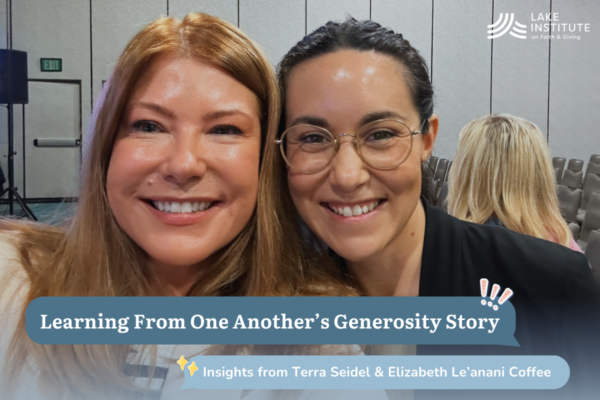
In this edition of Lake Insights, explore conversations on the past, present, and future of faith-inspired generosity. Dr. Jack Wertheimer, Lake Institute’s 2025 Distinguished Visitor, discusses the history and patterns of Jewish giving, while Managing Director Elizabeth Le’anani Coffee reflects on how faith leaders can shape a generous imagination that transforms communities beyond their own.
In this week's Insights, Josh Packard, PhD, highlights how younger generations express generosity through small, authentic acts of impact—micronarratives that prioritize trust, immediacy, and connection over institutional giving. David Edwards offers a lived example of that same spirit through a childhood lesson in presence and sacrifice. Together, their reflections reveal that generosity today is less about grand gestures or systems and more about showing up intentionally, faithfully, and meaningfully for others.
In this conversation with Rabbi Adam Miller and Elizabeth Le'anani Coffee, Dr. Jack Wertheimer speaks about the history of Jewish giving and Jewish giving practices in the present day.
David P. King, PhD, explores how faith-based organizations play a vital and often overlooked role in disaster response, offering resilience and hope when crises strike. Complementing his reflections, Rev. Rebecca Gurney shares a moving account from her North Carolina congregation in the aftermath of Hurricane Helene, illustrating how generosity, community, and faith come together to restore both roads and hearts.
This guide from Jewish Funders Network draws on timeless Jewish wisdom to support and inspire thoughtful, values driven philanthropy.
This issue of Insights explores innovative expressions of generosity within faith communities. Dr. Carlos W. Perkins reflects on the impact of ECRF cohorts designed for Black Christian leaders, highlighting how these spaces cultivate generosity, leadership, and legacy in culturally resonant ways. We also feature Dr. Anthony Riley’s story of applying ECRF tools to inspire his congregation at Central Baptist Church in Saint Louis, raising significant support for community outreach.
Insights is a bi-weekly e-newsletter for the religious community and fundraisers of faith-based organizations that provides: