

Consistency and the Practice of Generosity
Consistency and the Practice of Generosity
By David P. King, PhD, Karen Lake Buttrey Director and Associate Professor, Philanthropic Studies
 For as long as we have been tracking U.S. charitable giving, the largest subsector has been donations to religion (which includes predominantly congregations as well as denominations, missionary societies, and religious media). The first question that often follows is: why? Is there something unique about religious giving? I believe the answer is yes – and no. Giving across sectors shares a number of common values, motivations, and mechanisms, but for many individuals rooted in a religious tradition, there are particular giving practices that are often shaped by the teachings and rituals of the faith communities of which they are part. To make a finer point, for many religious donors, giving is a religious practice. And while religious practices can certainly emerge spontaneously, they are most often defined by their rootedness in regular rhythms and reflections.
Patricia Snell Herzog, Associate Professor at the Lilly Family School of Philanthropy, has defined four types of givers: impulsive, selective, habitual, and planned. Herzog reminds us that most Americans are impulsive givers. Habitual and planned givers, who rely on systems and routines in their giving, make up only 21 percent of givers. Interestingly, givers with higher levels of religiosity make up a higher number of these regular givers.
If many religious donors see their giving, at least in part, as a religious practice, then it may not be a surprise that they have an expectation of themselves to give consistently. The rhythms and cultures of giving differ across faith traditions, which may lead to various measures or expectations of consistency. In Christianity, for instance, teachings on tithes and offerings and invitations to give during weekly services might be among the strongest encouragements those worshipers receive to give consistently.
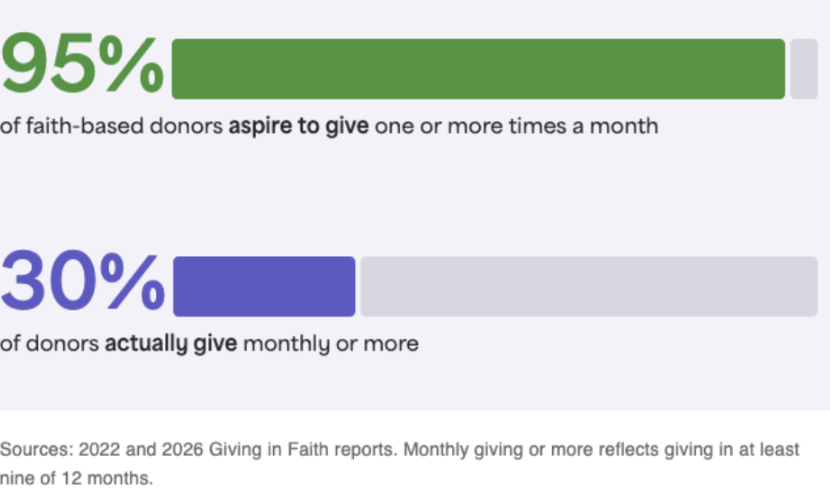
The 2026 Giving in Faith report, just released by our friends at Givelify Philanthropic Research, focuses on the topic of consistency. In their survey of nearly 2,000 Christian donors, they discovered that 95% of those donors aspire to consistency (which they define as giving at least monthly across most months). At the same time, only 30% of donors actually gave monthly or more.
 It might come as no surprise that church leaders are often even more optimistic about the consistency of their congregants. Through a survey of nearly 900 church leaders, Givelify found that leaders estimated that about half of their own congregations’ participants gave monthly or more.
If consistency is a built-in expectation for the vast majority of givers but only a minority actually meet that goal, how can religious leaders and faith communities help to bridge this gap? That question is even more pertinent if, as Givelify learned, many faith leaders overestimate giving consistency in their own communities and therefore miss opportunities to engage their congregants on the topic of giving.
If, for many, religious giving takes the form of a practice and many donors seek more consistency, perhaps like any good habit, we need to think of ways to make that habit stick. If you want to start a habit of running, for instance, you might set your shoes and running gear out the night before. You set the bar low, initially, and make first steps realistic – you don’t need to run a marathon in week one! Next, you can connect that habit with positive experiences anchored in existing habits—perhaps you want to run with a friend, listen to your favorite podcast, or run through neighborhoods and nature that you enjoy.
What are the cues that make religious giving a regular practice? For recent generations, those may have been an intentional time of passing plates in the worship service, a pledge campaign, or a prompt from the pulpit. What about the reinforcements and reflection? That might have been a thank you note, a testimony in a worship service, or opportunities to hear about the power of generosity through preaching, religious education, or service opportunities.
Those cues, invitations, and reflections on engaging in the practice of giving may be less evident in many congregations today. At the same time, more funds are coming in regularly and systematically from recurring, automated donations. These technologies are essential in many ways to givers, congregations, and nonprofits alike, but as donors themselves reflect, a recurring donation once initiated can fall out of sight, out of mind. While the rhythm may be there, the regular reflection on the intent and practice of giving that solidifies it as a habit faces the danger of fading away.
I believe that many religious givers strive for consistency because they understand their giving as a form of religious practice, not just a donation. But even as technology makes the utility of giving and giving regularly easier, it might inhibit the reflection on that same regular giving. This need not be the case.
Again, religious leaders have powerful tools to reinforce the cues and reflections on giving. To be clear, these tools must be used responsibly. As the Givelify study notes, one of the greatest barriers to consistent giving is uncertainty over personal finances or the larger economy. Religious leaders who compel giving indiscriminately with promises of material or physical rewards are not responsibly promoting good habits of giving. Instead, including holistic issues of financial planning and economic justice alongside teachings on faithful stewardship and generosity ensures that the focus is on the spiritual and material care for individuals and communities rather than the religious institution itself.
With shifts in giving cultures and rapid adaptation of giving technologies, religious practices are undoubtedly changing. But that does not mean that both leaders and individual donors can overlook the need to prompt regular reflection on the “why” of giving. Consistency may not serve as the be-all and end-all for giving, but the fact that so many religious givers seek greater consistency says something about how they view the practice of giving. Consistency may help to ensure they give a certain amount to meet a budget, a pledge gift, or a religious mandate, but it may more significantly serve as an opportunity for regular reflection and reinforcement for how giving shapes and even transforms both giver and recipient.
An urge toward consistency among religious givers is a challenge to religious leaders and faith communities not to press through an overly enthusiastic and exhaustive “squeeze” on congregants to give each week or an excuse to shy away from the topic of giving, even as funds come in from regularly recurring donations. Instead, it might serve as a challenge to open up moments of reflection to revisit the power that money and resources often hold over us, the gifts that generosity holds for the giver, and the ways in which the practice of giving compels religious givers to reflect on their faith and their relationship with the world around them.
Moves Management: A Framework for Cultivating and Strengthening Donor Relationships
By Rachel Perten, Director of Advancement, Central Conference of American Rabbis
 If you’re in a position of leadership within a religious institution—whether clergy, a lay leader, or directing a nonprofit—you already know that relationships are at the core of everything we do. We preach, teach, listen, guide, and gather—all in service of building community. So, when it comes to fundraising, it’s not always about asking for money. It’s about deepening relationships. That’s why a relational approach like Moves Management can be so powerful.
What is Moves Management?
Simply put, Moves Management is a framework for cultivating and strengthening donor relationships over time. A “move” is any intentional action that brings someone closer to your mission and community. It might be a personal thank-you note, a coffee conversation, or an invitation to get involved with a program. Each touchpoint is meaningful when it’s rooted in genuine care and connection. It’s not about pressure—it’s about presence. Done well, it reflects our deepest values: hospitality, gratitude, and shared purpose.
The Five Stages of Donor Engagement
Moves Management typically unfolds in five key stages:
- Identify – Who’s showing up? Who’s asking thoughtful questions or volunteering time? Pay attention to who might be ready for a deeper connection.
- Qualify – Learn more about these individuals—their interests, values, and giving capacity. Not everyone is ready to give right away, and that’s okay. This step is about understanding, not judgment.
- Cultivate – This is where the relationship deepens. Share the impact of your work, extend meaningful invitations, and create experiences that help people feel like insiders.
- Solicit – When the time is right, extend a thoughtful, personalized invitation to give. If the relationship has been nurtured well, this won’t feel awkward—it will feel like a natural next step.
- Steward – After a gift is made, say thank you. Show the difference their support makes. Keep them involved. Strong stewardship turns one-time givers into lifelong champions.
For examples and tips for putting this into practice, read the full article here.
Upcoming 2026 ECRF Courses

Participate in an upcoming in-person or online Executive Certificate in Religious Fundraising (ECRF) course this year and deepen your impact within your congregation or faith community. The next ECRF offering is a 3-day in-person course in Charlotte, North Carolina from August 31-September 2, 2026.
Explore the remaining 2026 schedule and secure your spot today.
Fall 2026 ECRF Scholarships

Executive Certificate in Religious Fundraising (ECRF) fall 2026 scholarship applications are now open! The Thomas H. Lake Scholarship provides $675 in financial support to help ECRF participants take part in this enriching experience. Ten scholarships are available for this scholarship cycle.
Applications are due by Monday, August 3, 2026. Applicants can expect to hear a decision from our team by the end of August.
Subscribe
Insights is a bi-weekly e-newsletter for the religious community and fundraisers of faith-based organizations that provides:
- Reflections on important developments in the field of faith and giving
- Recommended books, studies and articles
- Upcoming Lake Institute events