

Giving USA 2026 Report: What the Latest Data Means for Faith-Based Giving
Giving USA 2026 Report: What the Latest Data Means for Faith-Based Giving
By Erica Dollhopf, PhD, Associate Director of Research, Lake Institute on Faith & Giving
 The 2026 edition of Giving USA continues more than 40 years of reporting on giving in the U.S., offering a window into religious giving as well as giving to other sectors. The Lilly Family School of Philanthropy at IU Indianapolis researches and writes this annual volume, which the Giving USA Foundation publishes. Giving to religion for purposes of this publication includes giving to congregations, religious media, and missions, though it excludes religiously motivated or inspired organizations that are operating in a different sector.
Total giving in the U.S. for 2025 was $617.2 billion, representing a 5.7% increase from 2024 or 3% when adjusted for inflation, which is also the highest amount ever given in current dollars and the second-highest in inflation-adjusted dollars. Looking at this by subsector, most saw growth—particularly education, human services, health, arts, culture and humanities, and education—while religion remained relatively flat.
Approximately $152 billion was given to religion in 2025, which was a 2.4% increase from 2024-2025; adjusted for inflation, this represented a 0.2% decline. This is slightly higher than 2024, when the one-year increase was 1.9% overall, -1% adjusted for inflation. Looking at 2023-2025, while religion giving grew 5.8%, this was less than the total growth rate for giving during that time frame of 8.8%. Religion remains the biggest area of donations received compared to other subsectors—23% of all donations in 2024 and 2025—but at a declining margin. Whereas religion overall received 24% of all donations from 2021-2025, this is about half the share of giving to religion 30 years ago: the figure was 33% in 2011-2015, 38% in 2001-2005, and 49% in 1991-1995.
These trends continue to coincide with declining worship attendance and religious affiliation in the U.S. For instance, PRRI found that religious affiliation has continued to decrease in recent years, with 28% of Americans unaffiliated in 2024 compared to 16% in 2006. Similarly, a Gallup study found that the proportion of adults who say religion is important in their daily lives dropped to 49% in 2025 compared to 66% in 2015; notably, this is the largest drop over any ten-year period in any country since 2007 in Gallup’s polling.
Despite these trends in American religion, which have persisted at some level for decades, in addition to the shrinking share of giving going to religion, several hopeful trends still emerged from this year’s chapter. Even amidst these declines overall, compared to donors in general, religiously affiliated donors are highly engaged and intend to increase their future giving. In particular, the 2026 Virtuous Benchmark Report for Faith-Based Nonprofits, in analysis of groups using that giving platform, found that faith-based organizations had higher average gifts per donor (4.7 vs. 4.2 for the overall nonprofit sector) and average gift amount ($142 vs. $136). Also, Dunham+Company and the Giving USA Foundation™ conducted a survey in 2025 that found 81% of religiously engaged donors intend to maintain or increase their future giving, while weekly worship attendance overall increased the likelihood that someone would donate to their house of worship.
Shifts in the political and social landscape in recent years may have ongoing implications for religion and philanthropy. One such change was the IRS’s reinterpretation of the Johnson Amendment, which now permits houses of worship to endorse political candidates, which had previously been forbidden due to their tax-exempt status. Notably, most Americans oppose houses of worship endorsing political candidates, with PRRI finding that 75% opposed the idea in 2023. Another ongoing shift is the increased interest among congregations in adapting underused or unused property to benefit their surrounding community, which has resulted in opportunities such as partnerships between cities and faith-based organizations, as seen in the City of Charlotte and Enterprise Community Partners initiative to facilitate the assessment of housing development opportunities.
Finally, as faith-based organizations plan for their future, something they may want to consider is how they are engaging in planned giving. The 2025 Bank of America Study of Philanthropy: Charitable Giving by Affluent Households found that affluent households donated to religious organizations at a higher rate than the general population 38% compared to 30%); however, affluent donors only left an average of 4% of their estates to religious charities. Given that faith-based donors are generally interested in increasing their giving over time, it may be beneficial to cultivate relationships with donors around how estate planning might fit in with their future giving plans.
Although giving to religion has not seen the same growth as other giving sectors in recent decades, religion is still the largest recipient of donor giving from donors who are particularly deeply committed to this form of philanthropy. Giving to religion has many sources of vitality and will continue to benefit from the creativity and dedication of donors and recipients alike.
Big News in Philanthropy: Giving USA 2026 is Here
Charitable giving in the United States reached a historic milestone in 2025, crossing the $600 billion mark for the first time to hit $617.2 billion (a 5% growth in current dollars).
To help you dive into the data, we’ve gathered three excellent new resources:
- The Webinar: CCS Fundraising partnered with the Indiana University Lilly Family School of Philanthropy to unpack the report’s biggest findings, from shifting donor patterns to future trends nonprofit leaders need to watch. Watch the webinar.
- The Podcast: The Fund Raising School sat down with Christina Daniken, senior researcher and Editor-in-Chief for Giving USA, for an insider look at the data. Listen to the podcast.
- The Article: The IU Lilly Family School of Philanthropy Research Team offers a great overview of the report, including key findings and why this data matters. Read the article.
We invite you to use these resources to help navigate the full Giving USA 2026 report and guide your strategy for the years ahead!
Faith-based Capital Campaign: Your Blueprint to Readiness
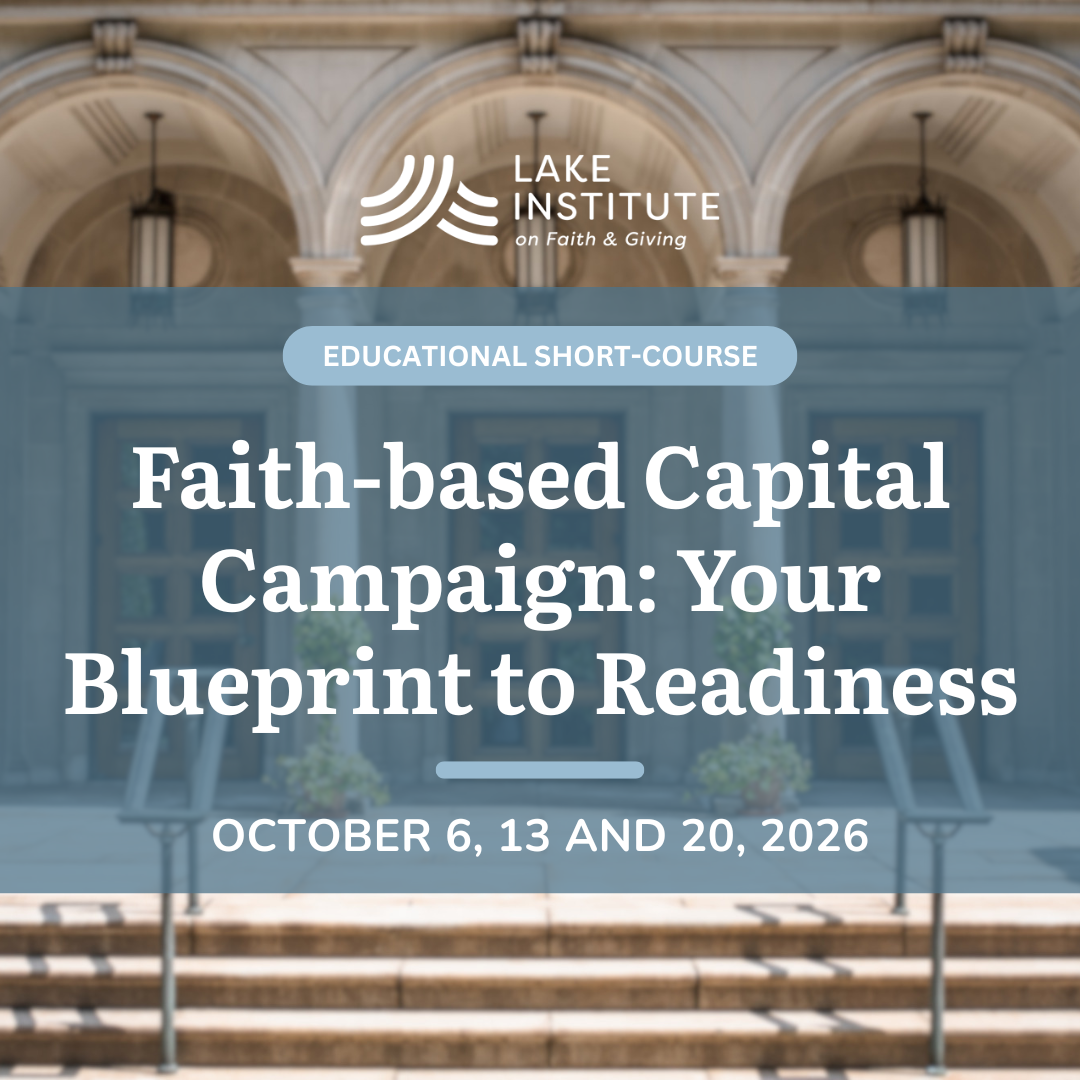
Planning a capital campaign? Start with a strong foundation. Join us this October for our short course, Faith-based Capital Campaign: Your Blueprint to Readiness
This course is designed to guide you through the discernment process: how do you set a financial goal, determine whether to engage an expert or consultant, and develop a campaign rooted in the vision of your community.
21st Annual Thomas H. Lake Lecture with Meghan Sullivan, PhD
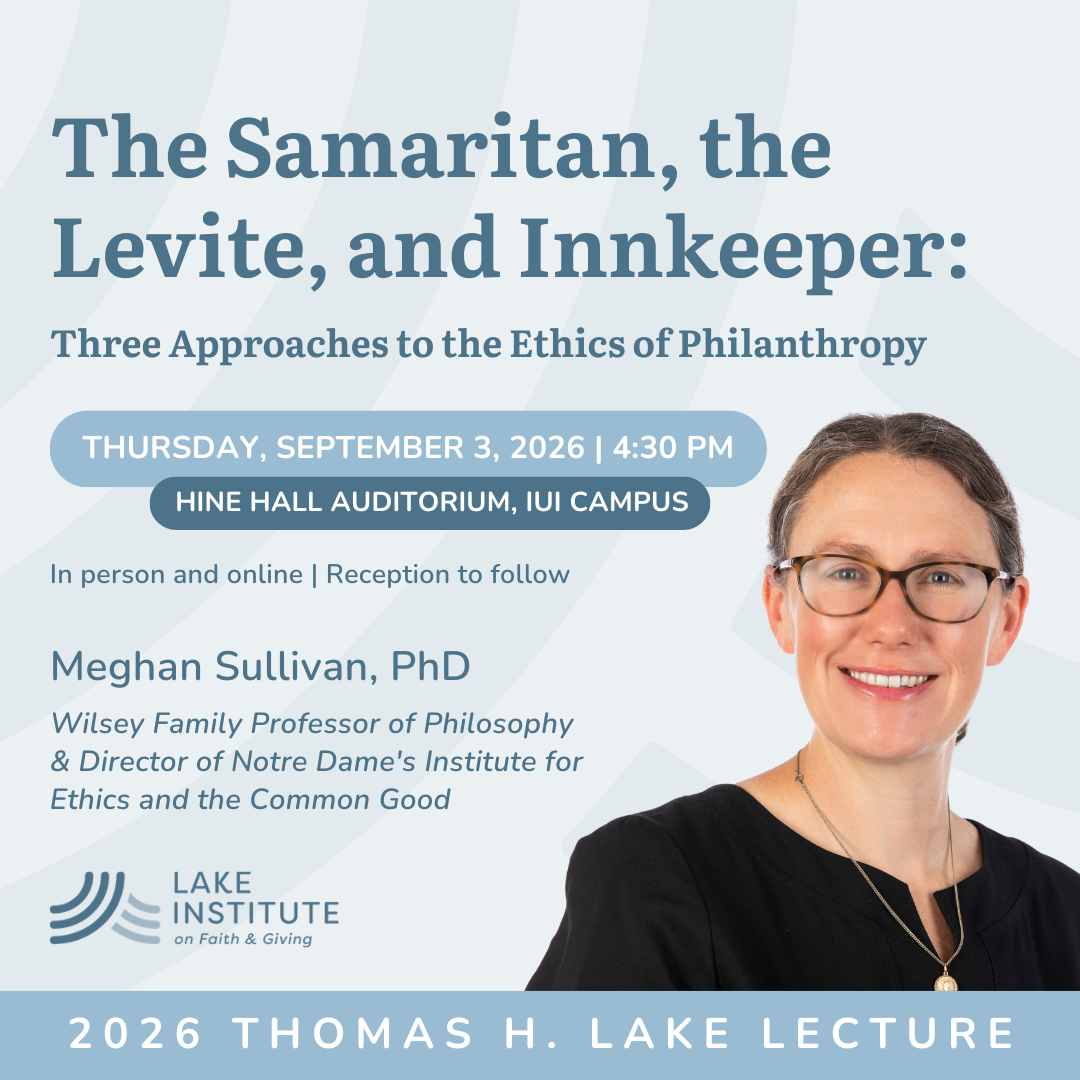
Join Lake Institute on Faith & Giving for the 21st annual Thomas H. Lake Lecture on Thursday, September 4, 2026, from 4:30 to 6:00 p.m. This year’s lecture, The Samaritan, the Levite, and the Innkeeper: Three Approaches to the Ethics of Philanthropy, will feature Meghan Sullivan, PhD, as she explores the moral foundations of generosity and the different ways we understand our responsibilities to others.
Subscribe
Insights is a bi-weekly e-newsletter for the religious community and fundraisers of faith-based organizations that provides:
- Reflections on important developments in the field of faith and giving
- Recommended books, studies and articles
- Upcoming Lake Institute events