
Habitat for Humanity—More Than Just Building Houses
Jonathan Reckford, CEO, Habitat for Humanity International, on building homes, communities and hope as the organization celebrates 50 years.
By Jennifer Donovan, Communications Manager, Indiana University Lilly Family School of Philanthropy
In celebration of Habitat for Humanity’s 50th anniversary of building homes, communities and hope, the Lake Institute on Faith & Giving, a part of the Indiana University Lilly Family School of Philanthropy, hosted the organization’s CEO, Jonathan Reckford, as a Lake Distinguished Visitor in March.
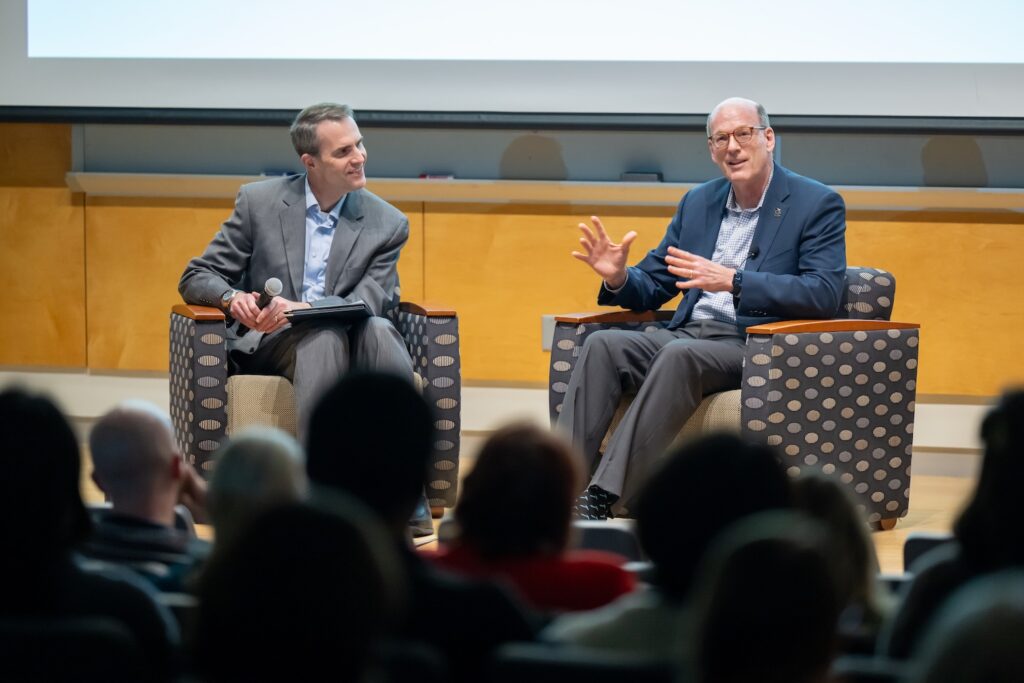
Since its founding in 1976, Habitat for Humanity has helped more than 65 million people globally build their futures through access to decent, affordable housing. The organization now works in all 50 states and in more than 70 countries. Over those decades the organization has undergone a profound shift from building houses to changing the systems that make housing unreachable.
When people think of Habitat for Humanity, they may have a misconception that the organization gives away houses, which is not true. The organization provides no-profit loans and requires partnership/repayment from families for the houses they build.
Furthermore, Habitat’s scope extends far beyond the construction site. The organization recognized that they were never going to build enough houses to solve the housing problem. “We actually calculated how many years would it take at compounding our quite fast growth rate to actually solve the housing problem. It was something like 1,032 years, which felt unacceptably slow,” said Reckford. “So that changed our framing questions from how many houses can we build to what it would take to actually address the housing need in all geographies we serve. That led us into policy and advocacy work and into what we call market development.”
As Habitat’s strategy has evolved, so has the role of its volunteers. They are no longer just “unskilled labor” swinging hammers, they are increasingly taking on roles as advocates. These volunteers help address broader systemic issues contributing to the housing shortage by influencing policy.
Those advocacy efforts are global. For example, in Bolivia, Habitat worked to change federal laws so that women and marginalized groups could legally own and title land, a move that enabled women to become property owners.
The efforts also include providing home-improvement loans to low-income families to enable them to upgrade their homes and the organization also provides video instruction on how to do the work. Television’s The Property Brothers, Jonathan and Drew Scott, appear in the instruction videos that reach millions in the Philippines, Peru, and Kenya.
Habitat has discovered that housing provides more than shelter. “The impact turns out to be very heavy around better health, educational, and psychological outcomes. It turns out stability is incredibly important for childhood development,” said Reckford. For example, health incomes have been noticeable in Kenya. A medical journal found that low cost housing improvements such as screening and cool-roof technology reduced malaria-carrying insects by 77%.
Like any nonprofit, diverse revenue streams are vital. One of the organizations’ most successful streams of revenue is Habitat ReStores. These housing thrift stores generated $750 million in revenue last year. These funds are recycled directly back into local communities to fund more construction, while the stores themselves provide a source of affordable home goods for families in need.
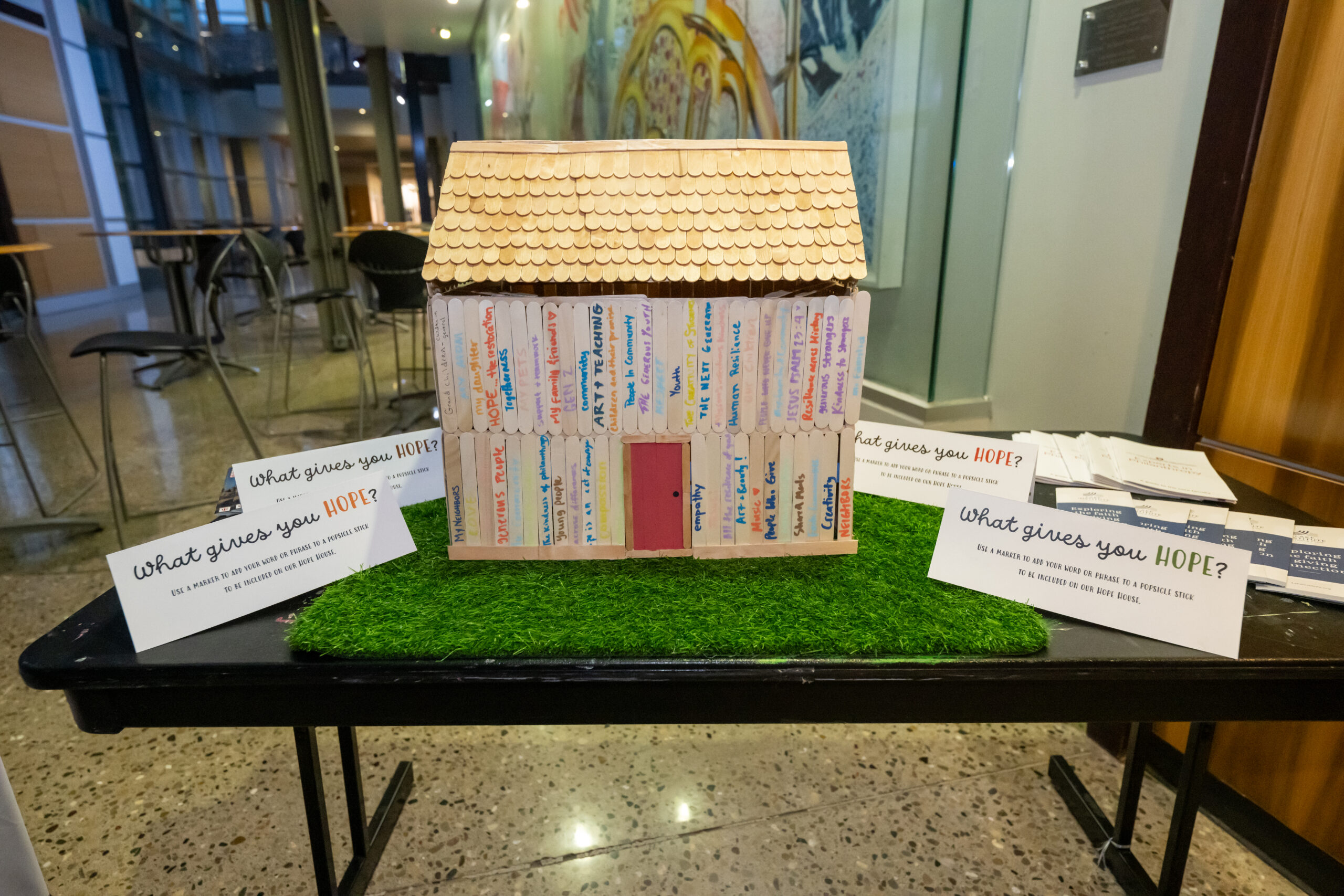 To honor Reckford’s visit, a symbolic popsicle stick home was constructed. Before the event, guests were asked to write what gives them hope on a stick. These individual contributions were then used to build the miniature house displayed after the lecture.
The project served as a reminder that communities are built piece by piece, relationship by relationship, and hope by hope. As guests departed, they were greeted by a home covered in words of inspiration, a reminder of the hope they can carry back into their own communities.
A recording of the full lecture, which includes Reckford’s personal journey to philanthropy is available here.