

Unlocking the Potential of Faith Communities for Local Impact
Unlocking the Potential of Faith Communities for Local Impact
A Note From Our Managing Director, Elizabeth Le’anani Coffee
Meagan Longley offers a rare window into how a funder is rethinking the boundaries of philanthropy. Not as a closed system, but as one that must rediscover its relationship with faith communities. While her reflections are written to fellow funders, they surface questions that matter for anyone invested in the well-being of neighborhoods and the futures we are shaping together. At its core, this is a story about what becomes possible when parallel worlds begin to see one another. Even if you don’t identify as a funder, her invitation is clear: pay attention to what, and to who we might be overlooking.
By Meagan Anderson Longley, MSSW, Chief Impact Officer, Austin Community Foundation
 Like many good stories, this one starts around the dinner table over Sunday supper. My mother-in-law is a retired Methodist clergy. She’d been working for the Central Texas Conference of the United Methodist Church for years, helping church leaders face the hard realities of shrinking congregations, rising costs, and aging infrastructure. As we enjoyed green chili stew on a cold night in Austin, she said, “I’d hate to see these properties lost to the market. Forever.”
This was a lightbulb moment #1 for me. At the same time my mother-in-law was supporting transitioning church properties, I was focused on housing affordability in my role as Chief Impact Officer at the Austin Community Foundation. In a rapidly growing city like Austin, Texas, land is one of the most cost-prohibitive elements of delivering new units of affordable housing. I wondered, might there be a path to partnership between faith communities and affordable housing developers?
Lightbulb moment #2 came a bit later. As I considered how we might work toward repurposing faith-owned property for community benefit, I realized how siloed the work of philanthropy and faith has become. Just as my mother-in-law and I shared details of our work over dinner for years without realizing the potential for partnership, so too have our sectors been operating along parallel paths in the community. However, if you can peel back a foundation’s strategic plan or a faith community’s particular theology, there exists the potential for powerful mission alignment.
At Austin Community Foundation, we’re focused on closing the opportunity gap in Central Texas through investments in economic mobility and housing affordability. As a place-based grantmaker, we’ve found natural partnerships with local nonprofits, community development financial institutions, and leaders in the public sphere. Our work has not been intentionally exclusive of faith communities, but neither has it been intentionally inclusive.
The speed with which church properties are closing – and will close – across our communities creates a sense of urgency and an imperative to explore how leaders across faith and philanthropy can find common ground. Austin Community Foundation is far from an expert in making this happen, but I am happy to share some lessons learned as we have waded into this space.
- Start the learning process. If this issue is new to you or your foundation team, data is an important case-maker. Mark Elsdon’s book, Gone for Good, explores the topic of faith-owned property transitions and offers case studies that will paint a picture of what’s possible.
- Find mission alignment. If your foundation hasn’t worked directly with faith communities in the past, it might feel like a strategic leap. Make connections based on the potential impact of the repurposed property: housing affordability, child care, arts, etc.
- Consider the tools in your toolbox. Foundations are built for grantmaking, but we have other valuable assets that can make a difference when considering faith-owned properties. Use your influence as a convener to bring sector leaders together for a conversation like we did. Consider impact investments to extend low-cost loans for redevelopment efforts.
- Identify partners. As you get started, it might be easier to work with and invest in the nonprofit partners that are leading redevelopment efforts. These are likely existing trusted relationships that you can leverage to explore a new area of work.
- Use a different playbook. Individual opportunities to retain faith-owned property for community good won’t happen predictably. Your typical grant cycle might not be a good fit for meeting the moment with flexibility and speed.
- Expand your risk tolerance. As you forge new relationships and explore new ways of working across sectors, expect that some projects won’t pan out. Many good ideas won’t make it across the finish line – that doesn’t mean the ideas aren’t worthy of investment.
- Get started. Identify an opportunity and go for it! Commit to allocating a portion of your grantmaking budget or impact investment portfolio to meet your good intentions with meaningful action.
- Move with both urgency and care. The reality is that faith-owned properties will close and either be sold and repurposed in line with market forces or with the support of philanthropy, be retained for the community’s benefit. The moment is now, but it won’t be forever. At the same time, faith leaders and congregants are facing difficult, emotional realities. Come to the table with this in mind.
In his book, Gone for Good, Mark Elsdon begins with a question: “Twenty years from now, when we look around our neighborhoods and realize that a third or more of our church properties are no longer churches, what will we have lost? Or gained?” He further asks: “What will each of us have done to encourage good…when churches are gone?”
I leave those same questions here for your consideration. As leaders in philanthropy, committed to sustaining and improving our communities, how will we meet the moment with both urgency and care?
Meagan Anderson Longley, a native Austinite, is the Chief Impact Officer at the Austin Community Foundation. In this role, she is responsible for ensuring the Foundation’s initiatives have a meaningful and measurable impact. In partnership with a stellar team, her work focuses on asset growth, fund development, donor engagement, grantmaking, impact investing, and community engagement. Meagan received her MSSW at the School of Social Work at UT Austin and did her undergraduate work at Furman University in Greenville, South Carolina.
Seeing What Was Always There
By Elizabeth Le’anani Coffee, Managing Director, Lake Institute on Faith & Giving

What Meagan names so clearly is not just an isolated missed opportunity. It points to a broader pattern worth noticing. Faith communities and philanthropy have been operating alongside one another for a long time, often animated by similar hopes for human flourishing, yet rarely structured for strategic collaboration. And yet, when we widen the lens, the significance of this disconnect becomes harder to ignore.
Recently, Lake was invited by Philanthropy Southwest to lead a webinar for funders exploring this very opportunity – where I shared research and then had the opportunity to interview Meagan. I’m encouraged because this invitation reflects a growing curiosity across the field. One that suggests this moment may be less about discovering something new and more about finally seeing what has been there all along.
Across the country, faith communities are not only spiritual centers. They are economic, social, and civic anchors. Research has shown that faith communities contribute millions of dollars annually in economic impact to their neighborhoods, often serving far more non-members than members. And they play a meaningful role in relational networks shaping opportunity and belonging. Still, much of this impact remainslargely invisible within dominant philanthropic frameworks.
At the same time, we are living through a profound transition. As Meagan notes, properties are closing (and will continue to close) at an accelerating pace. The question is not whether change is coming, but how it will be shaped. Will these assets be absorbed solely by market forces, or might they be stewarded in ways that reflect the deeper values and histories embedded within them?
This is where her reflection becomes an invitation. But the invitation is not just for funders to act differently. It is for all of us to reconsider how we define partnership, value, and possibility. The work ahead requires new language, new imagery, new relationships, new funding vehicles, and a willingness to move beyond familiar playbooks.
As Mark Elsdon asks in his book Gone for Good: when we look back on this moment, what will we have encouraged? And just as importantly, what might we have missed the chance to imagine together?
Related resources to check out:
- Harvard University’s Global Flourishing Program connected to their Flourishing in the Church study
Explore Lake’s Resource Library
Lake Institute’s Resource Library collects and curates a wide range of resources that can help deepen understanding and practice at the intersection of faith and giving.
You can search the Resource Library by keywords or browse themes to find current research, leadership insights, inspiring stories, theological reflection, and more.
2026 In-Person ECRF Opportunities
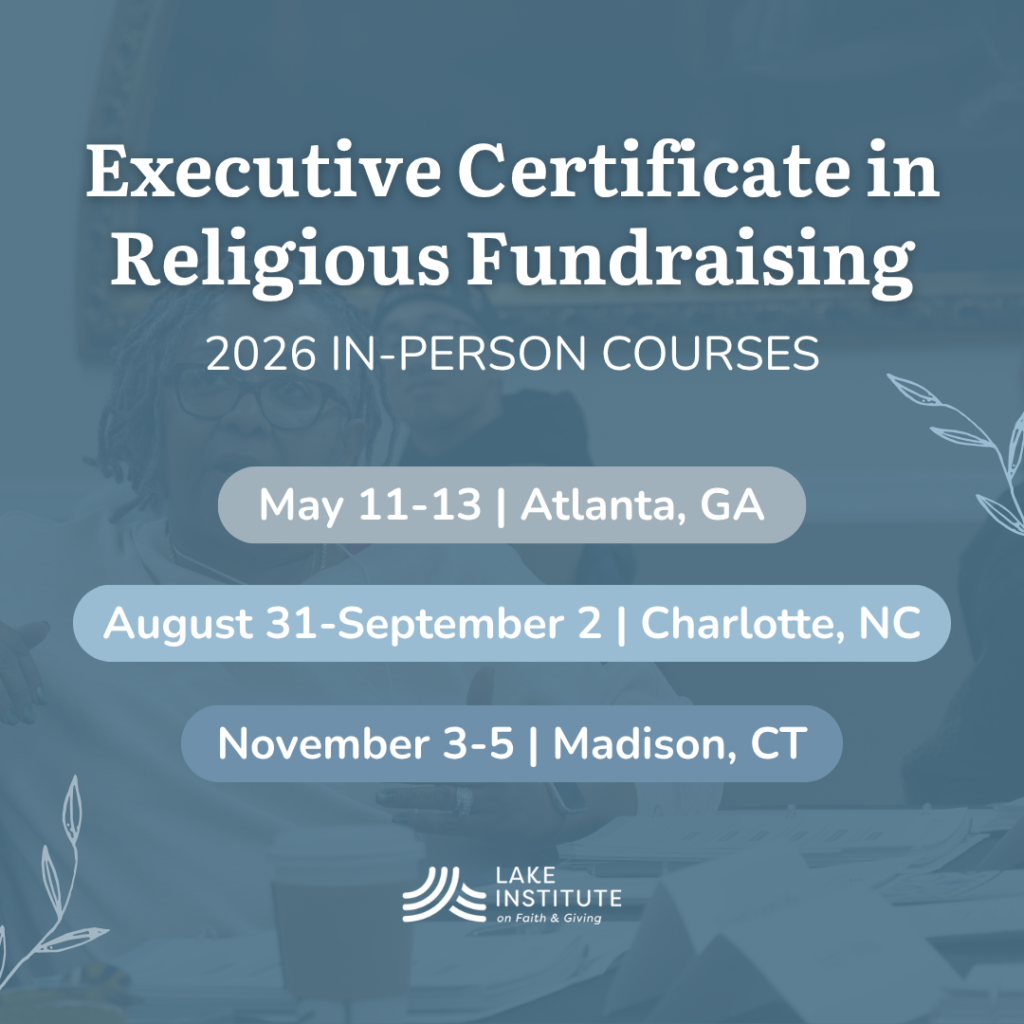
Attend an in-person Executive Certificate in Religious Fundraising (ECRF) course this year and deepen your impact within your congregation or faith community.
During the course, you’ll explore the spirituality and practice of fundraising while learning research-based tools and strategies unique to religious communities. Register today to reserve your spot!
Subscribe
Insights is a bi-weekly e-newsletter for the religious community and fundraisers of faith-based organizations that provides:
- Reflections on important developments in the field of faith and giving
- Recommended books, studies and articles
- Upcoming Lake Institute events