

Religion, Voluntarism, and the American Revolution
Religion, Voluntarism, and the American Revolution
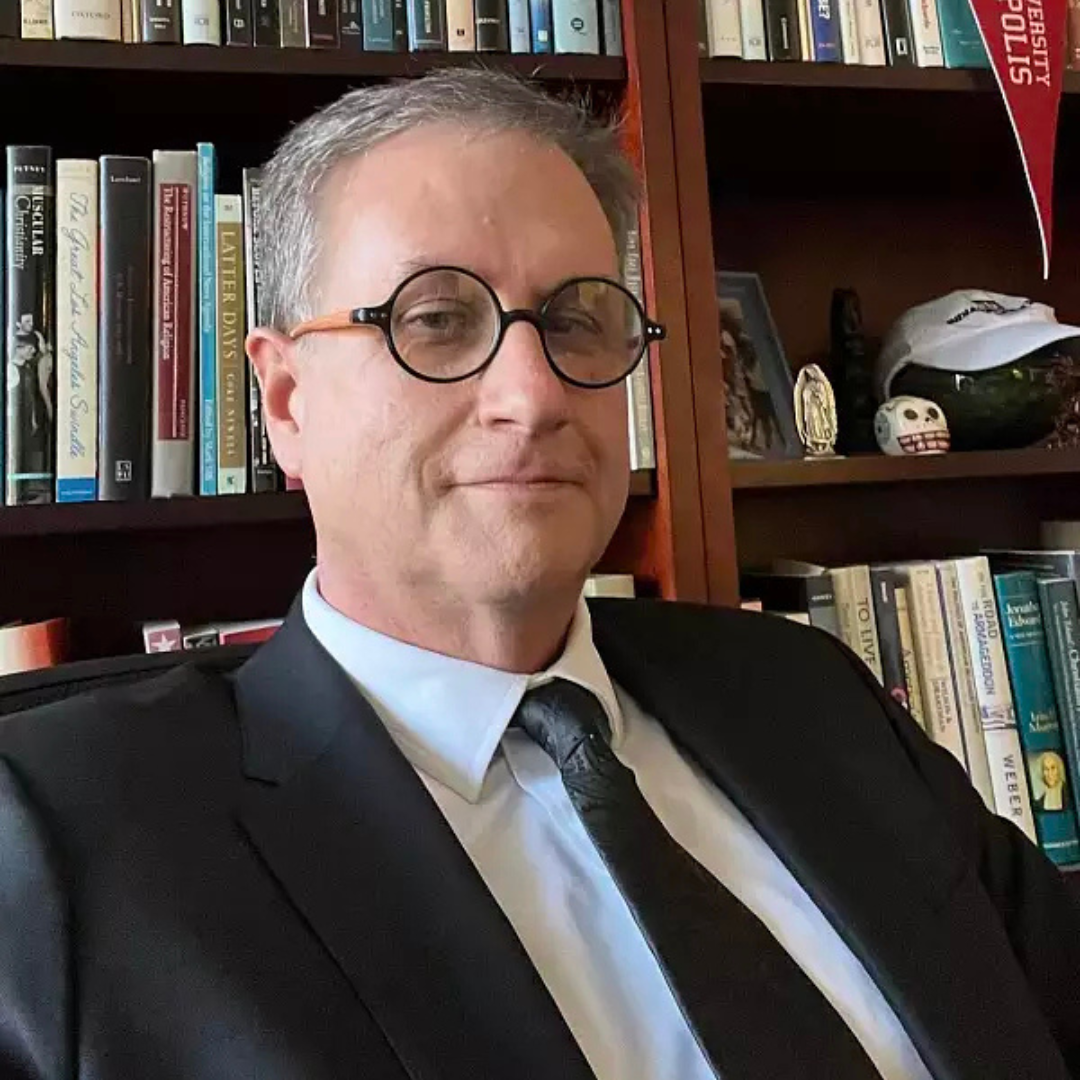
By Philip Goff, Chancellor’s Professor of History, IU Indianapolis, and Executive Director, Center for the Study of Religion and American Culture
 In the decade leading up to the bicentennial, which we celebrated fifty years ago, a debate arose among scholars around the role of religion in the American Revolution. Some thought there was a direct influence that found its core in the Protestant revivals that took place earlier in the century. Others argued that religion was merely the convenient and popular language used by those more affected by Enlightenment ideas. Each had evidence for their position.
The revivals of the 1740s created a web of communication among the previously disparate colonies. Newspapers, which were rather a recent commodity, shared stories of what was happening in Virginia for Boston readers. Benjamin Franklin made a small fortune by publishing the sermons of evangelist George Whitefield. For the first time, people sought out news about areas hundreds of miles away. Those who were involved in the revivals wrote to each other with reports of what was going on in their areas, which, scholars argued, set the stage for the “committees of correspondence” that developed in the early days of the Revolution. In other words, religion’s growing influence decades before 1776 set the stage for Revolutionary thought and actions.
On the other hand, some scholars emphasized the Enlightenment’s role, which appeared in two ways: The return to classical republicanism and in the ideals of the rights of individuals. The language of republicanism focused on civic virtue and the common good, based on ancient Greece and Rome. These patriots claimed that a free society requires people to emphasize the good of the entire community over their own private interests. Freedom, then, is a collective achievement. Meanwhile, classical liberalism focused on individual rights, liberty, and property. Leaning heavily on the political philosophy of John Locke, these patriots argued that people are born with natural rights that came before governments were created. The leaders of the American Revolution skillfully wove those two ideas together, despite their tensions.
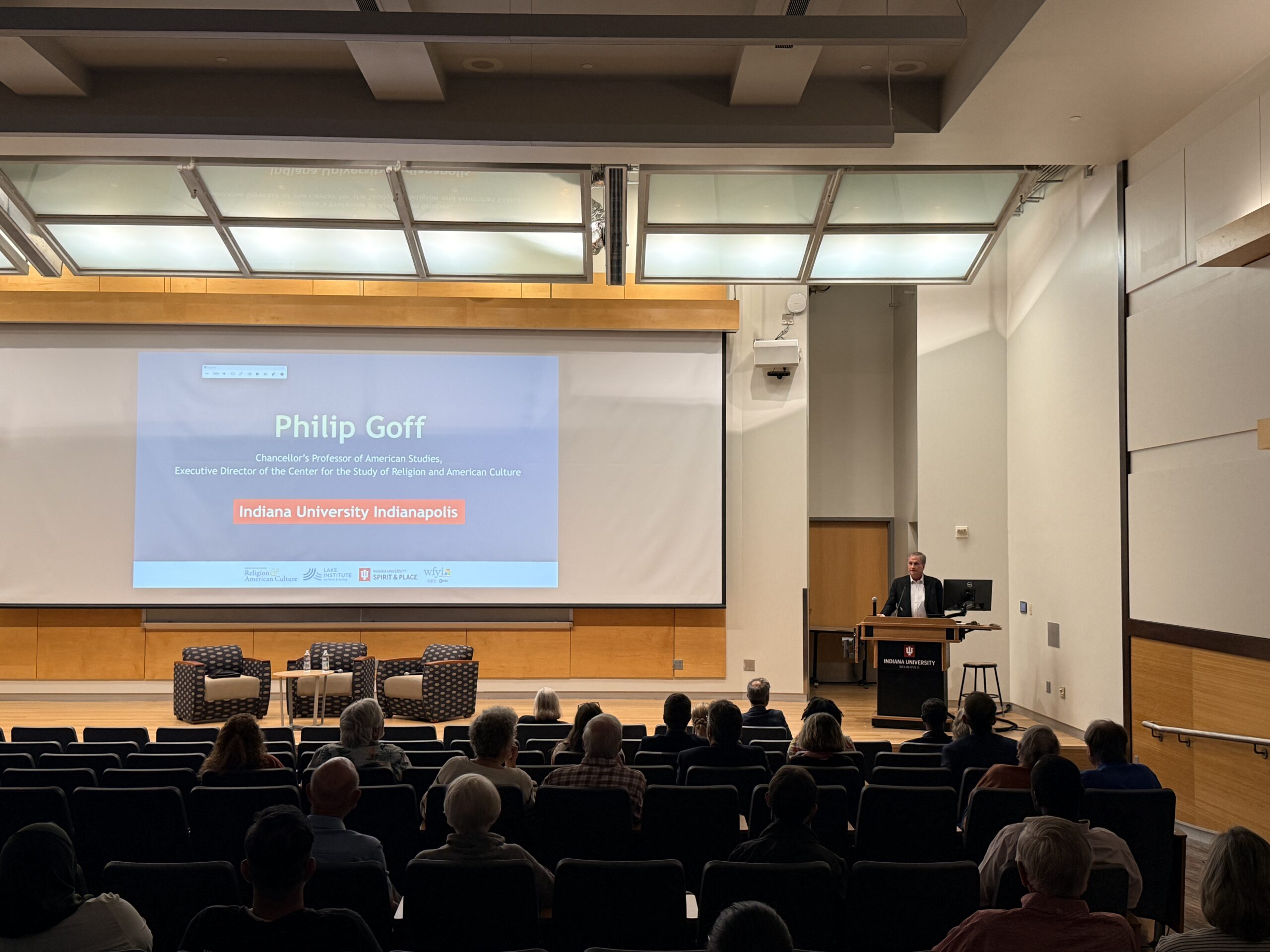
Philip Goff presenting during Revolutionary Religion event
But what about religion? What role did it play in inspiring people to participate in the revolution?
As we approach the 250th anniversary of the Declaration of Independence, the issue is still unsettled. Using Ken Burns’ recent PBS series “The American Revolution” as the jumping off point, several scholars gave their perspectives on religion and voluntarism in the Revolution. Hosted at Indiana University Indianapolis, the event was co-hosted by the Center for the Study of Religion and American Culture, the Lake Institute on Faith & Giving, Spirit & Place, and WFYI Public Media.
Elisabeth S. Clemens, the William Rainey Harper Distinguished Service Professor of Sociology at the University of Chicago, studies voluntarism and political movements. She led the audience through how people are moved to join social and revolutionary movements, placing that behavior in the context of the 1760s and 1770s. Like other political revolutions, much of the activity took place on the local level of voluntary groups. Filling the needs of state militias and the Continental Army because the nascent Continental Congress did not have adequate financial resources, they kept those fighting clothed, nourished, and as healthy as feasible in difficult days.
James P. Byrd, Cal Turner Chancellor’s Chair of Wesleyan Studies and Professor of American Religious History at Vanderbilt Divinity School, then discussed how the Bible was used in the pulpits and in the growing press to frame the Revolution for the masses. Some ministers pointed back to God’s disappointment in Israel’s decision to have a king in the Hebrew Scriptures. Clearly, they argued, God was against monarchy. Meanwhile, many of the leaders of the Revolution were, themselves, rather unorthodox in their faiths. Some were conventional Protestants, but many of the most famous—Jefferson, Adams, Franklin—held beliefs that were outside historic Christianity. The early push for religious freedom was the result of this mixture, emphasizing the right of conscience for all and no single established faith.
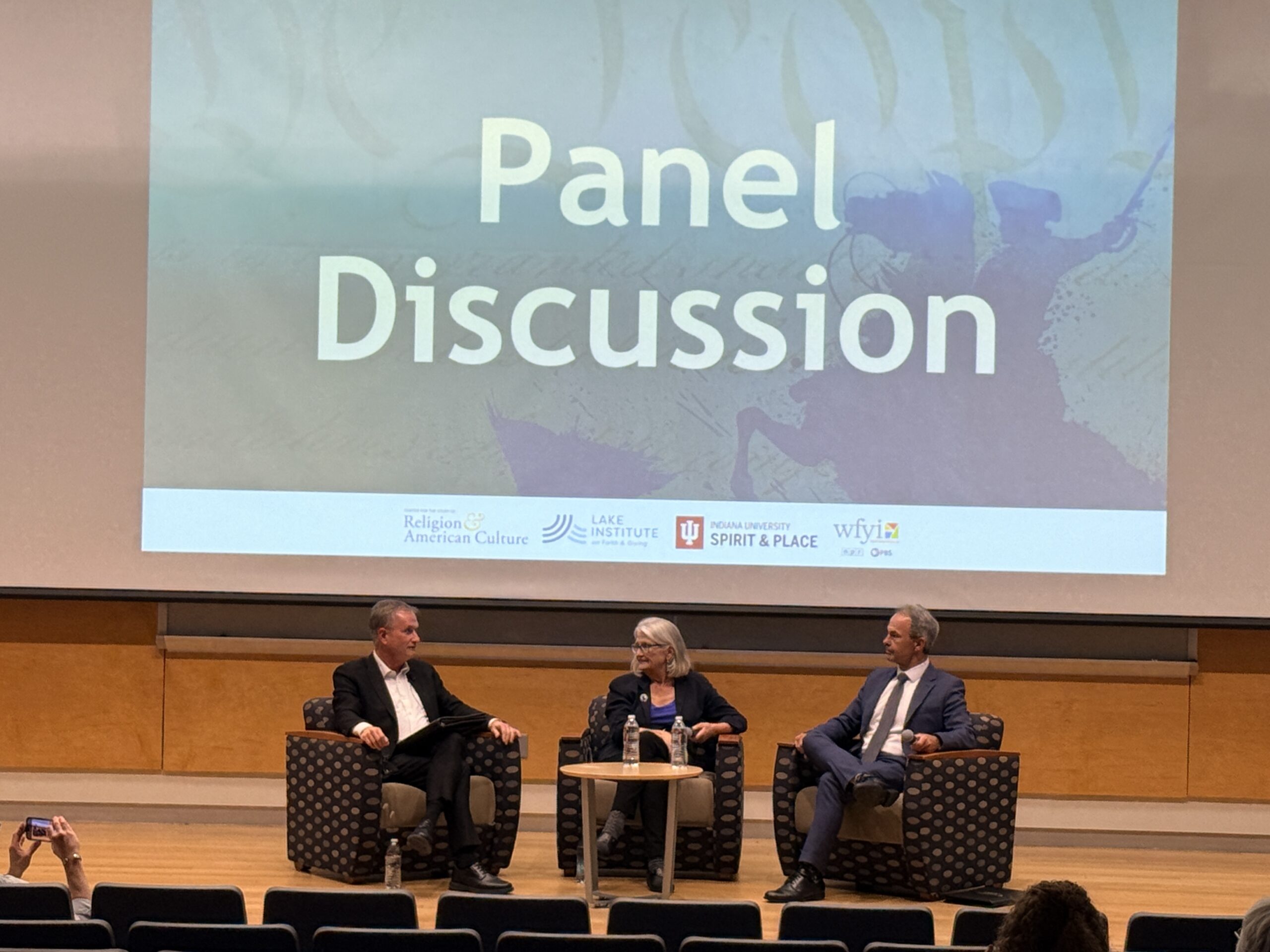
Philip Goff moderating panel discussion with Elisabeth S. Clemens and James P. Byrd (left to right)
Then I moderated a conversation with the speakers. Pushing further into their areas of specialization, it was clear that churches were among a number of voluntary organizations that mobilized patriots to revolutionary action. From elite clubs of influential men to local women’s groups who banded together to sew uniforms, to churches who hosted militia training and cared for the wounded, there were many voluntary organizations that sprung up quickly and played a crucial role in the Revolution.
The conversation then turned to matters the audience was most interested in. Because this was already an interactive event—audience members were invited to discuss questions among themselves after each speaker gave their remarks—there were many good comments and questions. One theme that emerged was the importance of churches, especially those in post-Puritan New England and the Baptist South, who had a tradition of choosing their ministers. This was a nascent form of democracy that took hold in the colonies and showed its strength in the governments set up in each state early in the Revolution.
Although the question of religion’s role in the Revolution will never be settled once and for all, its relationship to the larger role of voluntarism was made crystal clear. With a volunteer army that was inspired by a number of causes, including faith, the American Revolution was carried out against a conscripted British army that did not have the sort of personal commitment of the colonists. Between providing a revolutionary ideology that complemented republicanism and classical liberalism, and also providing the volunteers to make revolution possible, religion played a part in the American independence movement.
Philip Goff, Chancellor’s Professor of History at IU Indianapolis, has been the Executive Director of the Center for the Study of Religion and American Culture since 2000. Goff’s research specialization is American religious history, with eight books and over 200 articles, reviews and scholarly papers in that area. His recent books include: Civil Religion in America: Religion and the American Nation in the Twenty-First Century (with Rhys Williams and Raymond Haberski), The Bible in American Life (with Arthur Farnsley II and Peter Thuesen), and Religion and the Marketplace in the United States (with Jan Stievermann and Detlef Junker).
Faith, Giving, and the Pursuit of Civic Excellence
By Tasha Gibson, Senior Program Manager, Lake Institute on Faith & Giving
“I think to believe in America, rooted in the American Revolution, is to believe in possibility. That, to me, is the extraordinary thing about the patriot side of the fight. I think everybody on every side, including people who were denied even the ownership of themselves, had the sense of possibility worth fighting for.” – Jane Kamensky
Episode Six, The American Revolution, directed by Ken Burns, Sarah Botstein, and David Schmidt. 2026.
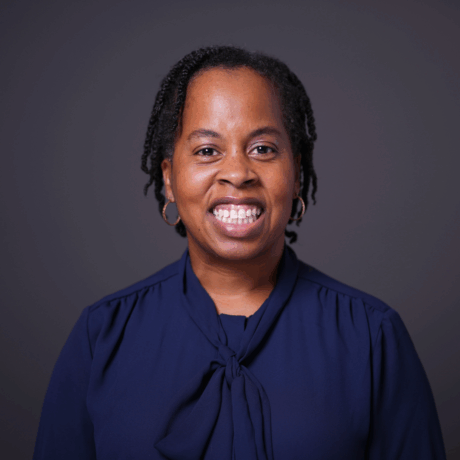 Reflecting on religion and voluntary action, with the help of Dr. Elisabeth S. Clemens and Dr. James P. Byrd, during the Revolutionary Religion: How Voluntary Action and Religion Shaped the American Revolution event, expanded what I learned through The American Revolution documentary series.
One of the things I’ve learned through the IU Lilly Family School of Philanthropy is that philanthropy is more than money. The original word philanthropy is comprised of two Greek words meaning “love of humanity”. But I also like the definition of philanthropy, attributed to Dr. Robert Payton and Dr. Michael Moody, that says philanthropy is “voluntary action for the common good”.
Dr. Clemens described, in more ways than one, how voluntary action was present during the American Revolution. She highlighted a sequence in the documentary that described how women, with little or no authority at that time, came together to act for a shared purpose. Their actions played a role in the American Revolution and are a part of a tradition of people, outside of government, forming associations for the common good.
In my work at Lake Institute on Faith & Giving, I’m often reminded that religion is more than ritual. At Lake Institute, I see examples of how religion can be acted out through expressions of generosity. Dr. Byrd described many of the complexities of religion’s role during the American Revolution, among other things. But one of the ways religion shaped during this period in America’s history was through promoting virtue, a character trait valued by many of the founders.
As much as virtue was encouraged during the American Revolution, and voluntary action was alive during that same time, I’m left with a question: how are faith and philanthropy being acted out in America today? The more pressing question for me is how do I want to live out my faith and philanthropy right now?
I, for one, will be making use of a digital resource guide we shared with event attendees to continue to learn and reflect on these questions. And I’m eager to be in more conversations about these distinct but also often uniquely linked concepts in America: faith and giving.
There is no question that these kinds of conversations are complex, demand continual learning, and require energy and time. Talking about faith and giving, religion and philanthropy, will require us to do something. However, I experience a deep sense of possibility for America by pursuing this kind of, in the words of Erin Kelley from Spirit & Place, “civic excellence”. And, to me, that is worth fighting for indeed.
The Revolutionary Religion Digital Resource Guide
Earlier this month, Lake Institute partnered with WYFI Public Media, the Center for the Study of Religion and American Culture, and Indiana University Spirit & Place to commemorate the 250th anniversary of the signing of the Declaration of Independence with a special event, Revolutionary Religion: How Voluntary Action and Religion Shaped the American Revolution.
To continue the conversation beyond the event, Lake and our partners have curated a collection of free educational resources, articles, reports, videos, and teaching tools that further examine the role of religion, generosity, and civic engagement in America, both past and present.
Fall 2026 ECRF Scholarships
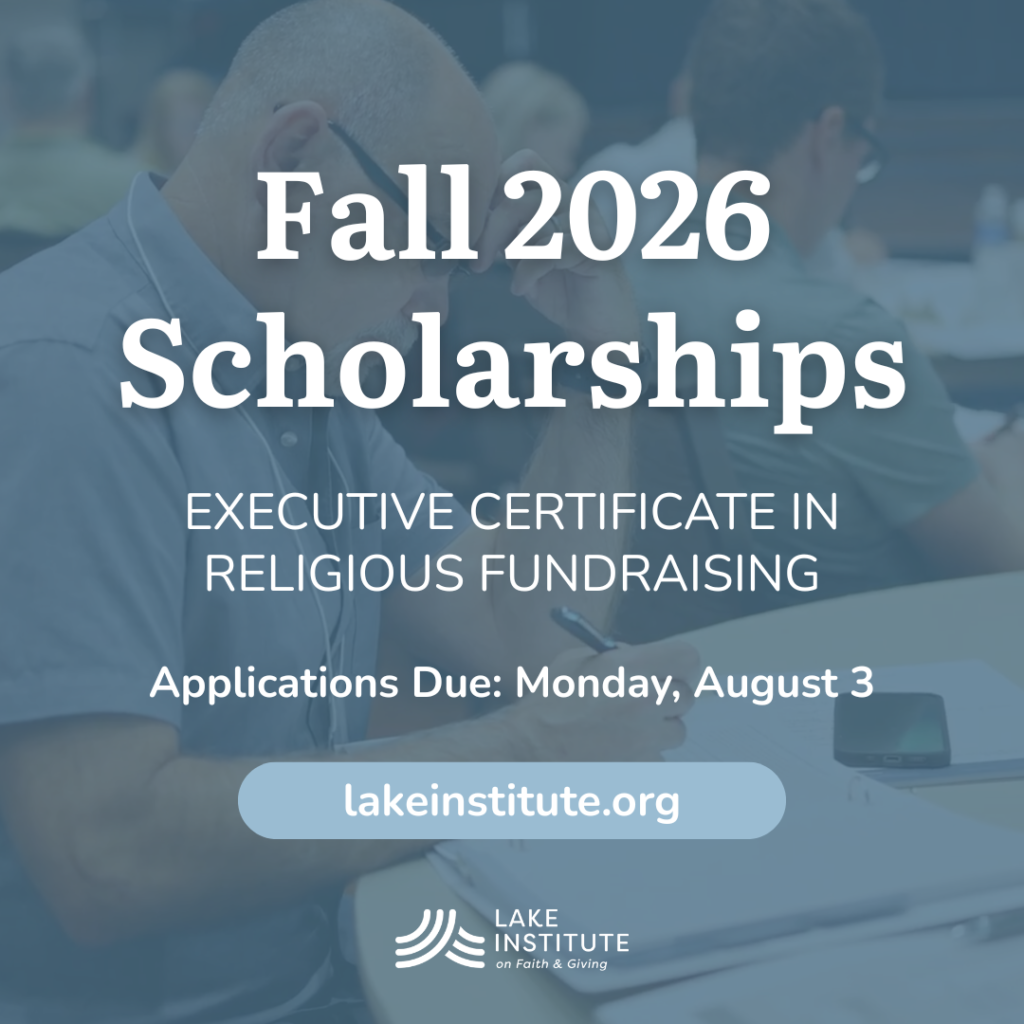
Executive Certificate in Religious Fundraising (ECRF) fall 2026 scholarship applications are now open! The Thomas H. Lake Scholarship provides $675 in financial support to help ECRF participants take part in this enriching experience. Ten scholarships are available for this scholarship cycle.
Applications are due by Monday, August 3, 2026. Applicants can expect to hear a decision from our team by the end of August.
Join Lake Institute's Summer Learning Challenge
Introducing Lake Institute’s self-paced Summer Learning Challenge! This isn’t your typical summer reading program. Instead, it’s a curated collection of Lake resources designed to help you strengthen donor relationships, spark meaningful conversations, and develop strategic plans for your congregation or organization.
After completing all four weekly challenges, you’ll be invited to submit a brief completion form for a chance* to win a copy of Madam C. J. Walker’s Gospel of Giving: Black Women’s Philanthropy during Jim Crow by Tyrone Freeman, Associate Professor of Philanthropic Studies at Indiana University Indianapolis.
*One winner will be selected at random and contacted by the Lake Institute team via email after July 31, 2026.
Subscribe
Insights is a bi-weekly e-newsletter for the religious community and fundraisers of faith-based organizations that provides:
- Reflections on important developments in the field of faith and giving
- Recommended books, studies and articles
- Upcoming Lake Institute events