

A Special Interview with Vivian Long & Elizabeth Le’anani Coffee: Faith, Culture & Philanthropy
A Special Interview with Vivian Long & Elizabeth Le’anani Coffee: Faith, Culture & Philanthropy
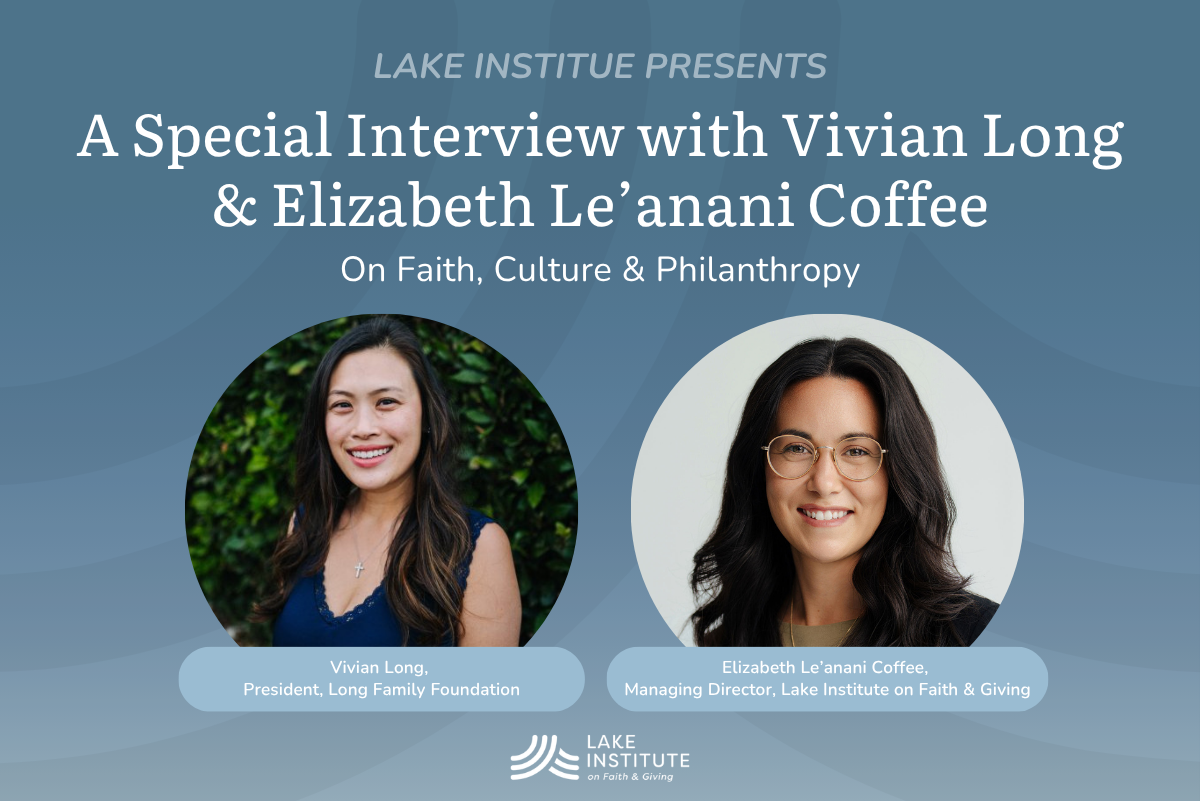
Vivian Long, Executive Director of the Long Family Foundation, and Elizabeth Le’anani Coffee, Managing Director of Lake Institute on Faith & Giving
In this issue of Insights, we’re highlighting an interview with Vivian Long and Elizabeth Le’anani Coffee, facilitated by Tasha Gibson. Together, they explore the intersection of philanthropy, lived religion, and cultural identity, with a specific focus on centering the experiences of Asian-American, Native Hawaiian, and Pacific Islander community members. Vivian is the Executive Director of the Long Family Foundation, bringing to the work a decade of experience in grantmaking and a background in advocacy for survivors of sexual assault. Vivian and Elizabeth share how their personal histories and ancestral roots have crafted their unique approaches to generosity and leadership.
The transcript below has been slightly edited for readability.
Earliest Memory of Giving or Receiving
Tasha Gibson (TG): What is your earliest memory of giving or receiving?
Vivian Long (VL): I think that one of my earliest memories of giving and receiving is the red envelope, or the lai see, that is very ubiquitous to the Chinese-American experience, probably the Chinese diaspora experience as well.
It’s a symbol of generosity that somebody is looking out for you. So lai sees are traditionally given by someone older, a parent, a grandparent or an uncle, and they’re usually given around a celebration or a holiday.
I was blessed enough to have multiple times growing up where I remember receiving lai sees from my parents, from my grandparents, from aunts and uncles. And I think that as I got older it became kind of this tether to my grandma, my pópo, who lived in Northern California, but was just so beloved to our whole family.
She immigrated from China, didn’t know the language, but the one thing that she always regretted was not being educated when she was a young girl. She found an English tutor, and so she would like really diligently write us notes with our lai see.
But for my grandma, I think of the gift that she gave to all of us was learning English so she could communicate with us.
And I’m really, really proud of her and really grateful for that, and all of these years that I had with her to get to know her.
TG: How about you, Elizabeth?
Elizabeth Le’anani Coffee (ELC): I had two things come to my mind immediately, and one of them was an envelope as well. Except mine was pink and from church. I remember my parents brought [an envelope] home and helped me understand how to fill it out.
I would put coins in there and put it in the offering plate. I remember being very curious and I think it was my dad, he pointed to a sconce in the sanctuary and he was like, “Your coins turn that on every Sunday.”
The other thing that came to my mind is my name, which was probably my first gift ever. My Hawaiian name, Le’anani, was given to me by my grandmother tūtū. She’s the elder in our family.
My mom’s side of the family is Hawaiian. My grandmother is native Hawaiian. The elder gives you your name, and [tūtū] told me that my name meant beautiful. I think what it’s come to mean over my life, and this is what she was trying to instill in me is, what does it mean to see beauty in all things, in everyone? And what does it mean to walk through life anticipating [beauty] to find you? That’s the gift she gave me and is also reminder of where I come from. Those two things have deeply informed how I think about gift and receiving.
Leadership and Cultural Influences
TG: You’ve talked a little bit about what you’ve observed growing up – the lived religion you observed and what you are still deciding you want to keep and what you might reinterrogate. I’m curious about who helped shape your leadership as you continue to think about philanthropy, generosity, and religion?
VL: Really what put my faith on a different trajectory was going on short term mission trips. I have a bit of a complicated relationship with short term mission trips, particularly at this stage in my life, as my theology has developed around mission work in general. But I will say for me, they changed my life. It opened my eyes to the places, communities, and ways of living that I would have never been exposed to otherwise. And I don’t just mean in the places that we visited. I also mean in coming together with a larger body of American Christians and understanding that my little Chinese American church in Southern California was a very different place than the megachurches that a lot of these other participants were coming from in the middle of the Bible Belt.
It was an element of connecting with somebody else in a context that you have no reason or business of connecting with. I think that informed my own philosophy around generosity and service.
ELC: I was also not in an American context, seeing a very different lived experience of generosity, gift, and faith and really made me evaluate what I ultimately believed. My dad’s a mediator; he teaches peace and reconciliation. This work ended up taking us into Pollsmoor Prison in Johannesburg, and we were working with folks who were inside of that prison. I was on the women’s side. Many of them had kept saying this was their second, third, fourth time serving time. All of them were mothers and almost all of them were serving because they were stealing food for their children.
They were not ashamed of why they did what they did or for the people they did it for. They were not ashamed of sharing about how even those decisions were informed by their faith and what new ethic they had to develop inside their faith to provide for their families in a world that was not built for them to thrive. That changed my life fundamentally.
TG: Do you see any connections between your cultural background, your cultural heritage, and that experience that you had in South Africa?
ELC: In the moment I wouldn’t have been able to make all those connections, but…in Hawaiian spirituality, when a volcano would erupt, they would then survey the land to see what new things [they] learned about God because the land had changed, because this eruption had taken place. So, there are going to be new things we didn’t know yesterday that we know today because of this change in topography. Being around these women, it felt like I was walking a new topography. They gave me the permission to say I thought I knew something and now I need to walk the land and figure out who or what are the assets and aspects of [God] that I don’t know, and I wouldn’t know without having had this experience.
A Foundation of Trust
TG: Vivian, I’m wondering as you lead the Family Foundation, where do you see your philanthropic practices being informed by both your faith and your culture?
VL: I think one element about the foundation that I’m grateful my parents had the wherewithal to build into its DNA is that their hope for it is that it exists in perpetuity. As the years have gone by, we’ve reconsidered what that actually means. The goal for them was that it was some sort of vessel for family connectedness to remain through generations, through this shared activity of giving.
To do that, we realized very early on there’s two ways in which you can achieve that. One is extremely high levels of control and the other is high levels of flexibility. My parents paved the way for us to go down the path of the latter. That’s an incredible gift that they’ve given to us because it shows a high level of trust.
For our foundation, the way that that presents itself is that we see ourselves as ever evolving. We are a foundation that has four pillars: religion, education, culture, and research. But as you can imagine, pretty much anything can fall into one of those four pillars. They are not super specific, and we don’t have plans to try and change the mission of the organization.
We want it to be something that can truly be inherited by future generations for them to interpret faith in the way that they’re experiencing it, culture in the way that they’re experiencing it, the needs of the planet, in the way they’re experiencing it. God willing, that is going to look very different from generation to generation.
For me, there is this question of how we can be committed partners and not feel like every six months the Long Family Foundation is going to change what it’s interested in. But that we are also nimble enough to be able to say, hey, there is a new interest from our family in this area and we’re going to try to pursue it because we feel like that’s what God has called us to do.
In this current iteration of the foundation, I think one of the things that we’ve really come to understand is that something with a lived experience is the most meaningful to us.
The areas of focus that we currently are committed to are areas that are really personal to our family. And beyond that, I think there are areas in which we feel we can provide some additional support around because either we understand the topic or we are also have lived out these experiences. We have found that that has made our partnerships much deeper, has lent itself to develop more trust between us and the nonprofits and the communities that we serve.
Larger Philanthropic Landscape
TG: How do family foundations fit into the larger philanthropic landscape?
ELC: I was talking with a family foundation leader recently who said she really believes that they can function with urgency and care. There’s a way to do both. Foundations have historically not been seen to do either very well, depending on how big they get. So for foundations that are deeply embedded in community, like Vivian was saying, trust is key. Trust in the community gatekeepers and leaders to be exactly who they are and then just support them and listen to them. I feel like that allows for urgent response and care to happen simultaneously.
What I also really respect about family foundations, whether its issue based or regional based, the ones that are doing some really profound work are doing it over the long term. They are able to stay and commit to partners, like Vivian’s talking about, in the multi-year fashion and really help.
I think this is a clear benefit of a nimble and small foundation. I feel like to be proximate to the people and to the issues, there’s an opportunity for there to be less of a translation issue between what’s really being faced by community members and then funding priorities.
VL: One thing we’ve been navigating through is originally my dad use the word unity a lot, and my sisters and I immediately recoiled at it. I don’t know why because we don’t have that much conflict, so it shouldn’t have felt bad, but it just didn’t feel like the right word.
Even now, in our work with community, I’ve been asking myself, “what is it exactly that we’re looking for in communities?” It isn’t the absence of conflict. The word that we’ve been trying to use now is healthy. Because to me, a healthy leader or a healthy community, a healthy ecosystem, and we could think about the planet that God has given us – a healthy ecosystem is one that is strong enough to withstand conflict and disruption.
I think about that in the sense of what we’re trying to build for the family at the Long Family Foundation. I anticipate that as more generations, as more family members join the foundation, we are going to have disagreements. I mean, we have had disagreements, to be clear, but I anticipate they’ll be more and they’ll probably be more fundamental because there’s going to be questions of how things are interpreted and how each lived experience is honored.
There has to be an agreed upon expression of how they choose to steward the resources that have been entrusted to them. For me, the only way that we are going to have a healthy foundation is if there’s a healthy family culture or at least an intentional building of healthy practices around conflict, disagreement, interpretation, and joy.
Introduction to Grantwriting for Faith Leaders

Lake Institute on Faith & Giving is offering an online short course in August 2026 that will provide faith leaders with an introduction to grantwriting.
Participants will learn the role grant funding can play in your organization’s approach to resources, learn about basic fundraising tools from the perspective of grant funding, and receive practical tools and strategies to find and successfully write grants.
Subscribe
Insights is a bi-weekly e-newsletter for the religious community and fundraisers of faith-based organizations that provides:
- Reflections on important developments in the field of faith and giving
- Recommended books, studies and articles
- Upcoming Lake Institute events