
Church Hosts Addiction Recovery Clinic
Church Hosts Addiction Recovery Clinic
Adapted from A church and health center collaborate to provide care for people with substance use disorder by Lindsay Peyton for Faith & Leadership.
A United Methodist church in Galveston, Texas, has transformed unused Sunday school classrooms into a free, walk-in clinic providing treatment for people with substance use disorder (SUD).
Galveston Central Church has long served the city’s unhoused and underserved residents, offering meals, showers, bicycle repair and other essential services. That history of service created deep trust within the community — a foundation that made it possible to expand into health care.
Today, in partnership with the University of Texas Medical Branch (UTMB) and St. Vincent’s Hope Clinics, the church hosts both a primary care clinic and a dedicated SUD Clinic offering medication-assisted treatment at no cost.
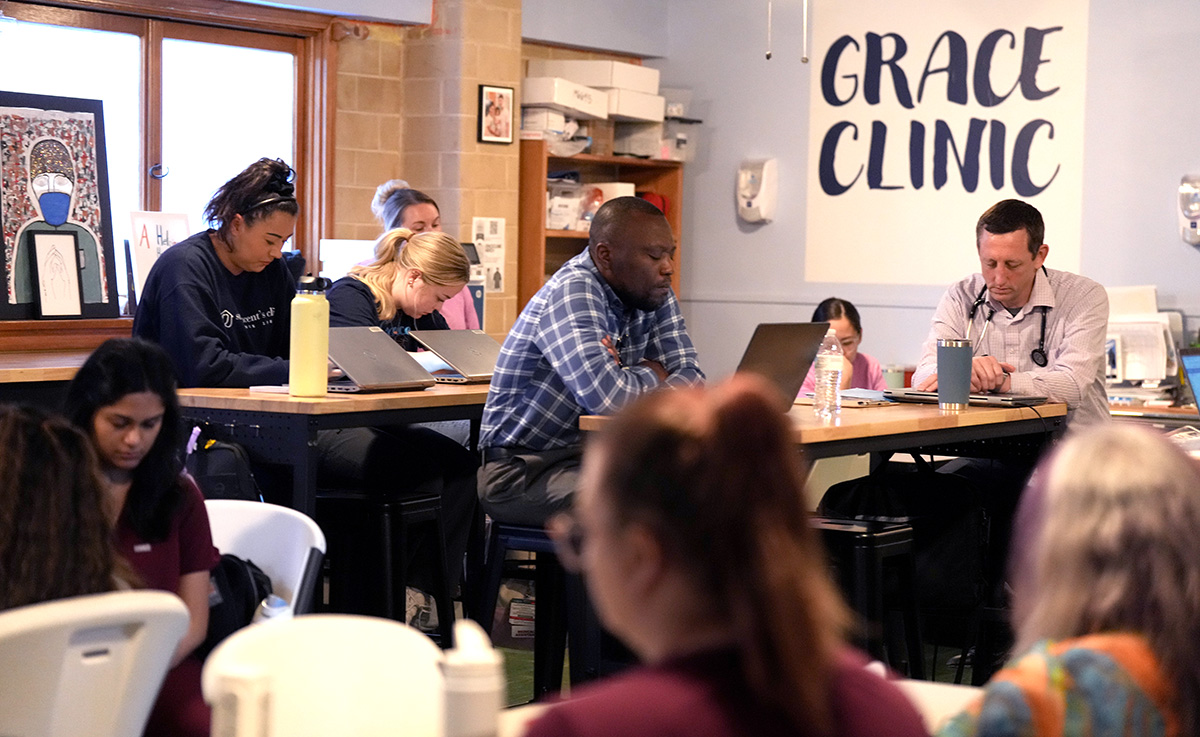
Each Tuesday morning, an interprofessional team of doctors, medical students, counselors, social workers, peer coaches and researchers gather on the church’s second floor to see patients. Walk-ins are welcome, appointments are not required, and patients do not need insurance. About 20 patients are typically seen during the three-hour clinic session. The environment is intentionally nonclinical: no white coats, no badges, and a strong emphasis on dignity and respect. The Rev. Michael Gienger, the church’s co-pastor, describes the clinic’s approach as “flipping treatment on its head.”
Many patients have been coming to the church for years and view it as a safe place. That familiarity lowers the threshold for seeking care, especially for people who have faced stigma or rejection in traditional medical settings.
Patients receive medications such as Suboxone, which reduces cravings and overdose risk, along with mental health care and social services. Shelby (who, like other clients, requested that only her first name be used in this article), struggled with fentanyl addiction. She credits the clinic’s free medication and nonjudgmental care with helping her achieve seven months of sobriety. Lacey, who lost her insurance, relies on the clinic to stay clean. Angela, sober for more than a year, says the clinic saved her life after a physician recognized signs of kidney failure and rushed her to the hospital.
The church’s evolution into a hub for health care began during the COVID-19 pandemic, when Galveston Central partnered with UTMB to host a vaccine clinic for Spanish-speaking and unhoused residents. While mistrust in the health care system and logistical barriers often keep vulnerable populations from accessing care, the church learned that the trust it had earned made it a safe place to ask questions, see familiar faces, and receive health services.
In 2021, the church launched Grace Clinic, a pilot program offering free primary care in their unused Sunday school space. The program expanded in 2022 and later added the SUD Clinic in response to rising overdose deaths. Because of the success of Grace Clinic, Rev. Gienger was confident in the ability to provide nonjudgmental care, which would become even more critical in treating addiction. Funding from an external partner helped make the expansion possible.
UTMB faculty say the clinic also provides invaluable training for students, who learn to treat addiction and poverty with empathy while working as part of an interdisciplinary team.
Since opening, the clinics have helped patients regain housing, recover mobility, return to work and rebuild their lives.
“We’ve seen folks that have had their lives dramatically changed,” Gienger said. He spoke of a patient who lost his sight, then his job and finally his housing. Now, after obtaining corrective surgery through the clinic, he has a job as a hotel manager.
While relapse is recognized as part of recovery, leaders emphasize that success often begins simply with showing up — and feeling welcome enough to return.
The clinics have reshaped church leaders’ understanding of ministry. Gienger and co-pastor the Rev. Julia Riley view mental and physical health as inseparable from spiritual well-being. They also see church property as an asset meant to serve the community every day of the week.
“Sunday is the least interesting thing we do here. It’s nothing compared to what people are experiencing with the resurrection on Tuesday and Thursday,” Gienger said.
Though small in size, Galveston Central’s impact is far-reaching. By opening its doors to unconventional partnerships and redefining how care is delivered, the church has created a model of compassionate, accessible treatment — one that offers not only medical care, but belonging and a chance at renewal.
This story is part of Lake Institute’s story collection, the Faithful Generosity Story Shelf, which highlights congregations and other religious organizations who have sought to use their assets and resources in creative—and sometimes surprising—ways as an expression of faithful giving.
Each entry in our Story Shelf is short enough to be read and discussed during a committee meeting or other group gathering. Our hope is that these accessible vignettes will spark new questions, conversation, and imagination among clergy and laity about what might be possible with the funds, buildings, land, and other resources in their care. If you know a story that should be included in the Story Shelf, suggest it here.
Subscribe
Insights is a bi-weekly e-newsletter for the religious community and fundraisers of faith-based organizations that provides:
- Reflections on important developments in the field of faith and giving
- Recommended books, studies and articles
- Upcoming Lake Institute events