

A Day of Abundance
A Day of Abundance
By Lana Miller, Pastor, Community Mennonite Church
 The Bible is filled with passages describing God’s abundance, which overflows and always provides for God’s people, making sure they have enough. We see God’s abundance, from the vitality of the creation stories (Genesis 1 and 2, Psalm 104) to the deserts in Exodus, where the people receive manna and quail (Exodus 16). The maternal image of God in Isaiah 66 is another kind of abundance, that of a mother feeding her child exemplifies the maternal gift economy that Robin Wall Kimmerer so eloquently writes about. In the New Testament, we encounter loaves and fish being multiplied, Jesus’ own life, and the pouring out of the Holy Spirit on the new community of Jesus followers, who leave changed, motivated to share and care for one another. God’s continuing activity of abundance surrounds us in creation and in the sustenance we receive. It is out of God’s abundance that God’s people are invited to share their abundance with others. As both a recognition and an offering, remembering that all we have is a gift, we decided to practice giving from our abundance one Sunday morning.
Two weeks before our “abundance” worship service, I invited everyone in the congregation to begin to consider their own abundance. Whether it be something from their garden, something they made, a plant or another cherished item in their home. Something that they loved but wanted to share and give a new home. Something that they had more than enough of.
Here is the advertisement in the newsletter inviting the congregation to consider their abundance:
- Is your garden producing more squash, beans, or cucumbers than you can eat? Bring them.
- Have you collected too many bags? Bring them.
- Is there too much hay when you mow your lawn? Bring it.
- Do you enjoy baking or making things and would like to gift the products of your labors? Bring them.
- Have your children grown out of their clothes, toys or are there games needing a new home? Bring them.
- Is it time to divide your house plants? Bring them.
- Are there good things lying around your house that you would like to have a good home? Bring them.
- Do you have more money than you need right now? Bring it for the compassion fund.
Let’s experience abundance together!
The morning of the service, people eagerly came into the worship space, carrying plants, flowers, herbs, pottery, paintings, puzzles, candles, fresh vegetables from their gardens (like green beans, peppers of every variety, tomatoes). There was lavender, toys, woodworking, baseball cards, and even a nice pair of mud boots. If you could imagine it, it was there.
That Sunday, we talked about interdependence and our need for one another, surrounded by a world that touts independence. We discussed Robin Wall Kimmerer’s writing on a “gift economy” shared in The Serviceberry. Noting how wealth, in a gift economy, is understood as having enough to share, and the practice for dealing with abundance is to give it away. We considered our relationships with one another, our ongoing need to participate in reciprocity, and observed that flourishing is mutual.
We noted the history of mutual aid as marked by the followers of Jesus from its beginning. In the early centuries, outside observers were struck by the charitable actions of believers among themselves as well as toward non-believers. They readily cared for the ill and needy–even at risk to their own lives. Among the early Anabaptists, it was common in baptism for new believers to pledge to share their possessions if other community members had need. And, for Mennonites, there remains a strong emphasis on mutual aid, informally and organized, meeting the needs of neighbors near and far.
At such a time as this, I invited the congregation to consider how we might cultivate a gift economy, a spirit of generosity that reflects God’s abundance. Many would suggest that cultivating gratitude is at the heart of this endeavor. When we recognize and appreciate all that we have, we are more ready to share with others.
And so, that morning, I invited everyone to reflect on their abundance and share it as an act of gratitude, a way of creating community and a way to recognize our Creator, the one who continues to give life and longs for us to give life to others.
During the offering, as the gifts kept coming, my eyes widened with the incredible assortment of generosity on display. Everything was given with sheer joy and love. People considered their abundance, not with just material things, but with time, gifts and talents. One person shared how they had an abundance of safety at such a time when so many immigrants and people of color are feeling more and more vulnerable. And they were challenged to consider how to share this kind of abundance.
After the last song, during the benediction, all were invited to enjoy the abundance of God in all that had been offered. At first, people didn’t take me seriously. Really, “come and take something,” I pleaded! I couldn’t imagine that all that had been offered would really find a home, so I was making plans to take things to the local reuse shop the next morning. But, to my delight and surprise, everything found a home! Even the teddy bear my daughter had crocheted with love.
That was a message in and of itself. When we share our abundance, someone always needs it.
Lana Miller (she/her) serves as one of the Pastors at Community Mennonite Church in Harrisonburg, VA. Her focus is on Congregational Care, and she also relates to the Community Life and Outreach Commissions. She supports Stephen Ministry, the Congregational Support Team, Small Groups and other care ministries. In addition, she provides pastoral care, leads a Bible study, teaches, and preaches. Prior to beginning ministry at CMC, Lana was a campus pastor at EMU and a Stewardship Consultant with Everence Financial. Lana graduated from Goshen College and Eastern Mennonite Seminary with a Master of Divinity and a focus on Spiritual Direction. Lana enjoys spending time with her family, reading, baking, gardening and canning, being outside in nature and going on walks.
What We Hold, What We Share
By Elizabeth Le’anani Coffee, Managing Director, Lake Institute on Faith & Giving
 In Hawaiian, the word for wealth is “waiwai.” It comes from the word for water: “wai.” To me this is an invitation to understand wealth and the sharing of wealth through the ways of water.
Water is not to be hoarded. It was never meant to be bought or sold. It moves powerfully, even devastatingly. Too much of it or too little of it creates suffering.
So “waiwai” is never about accumulation. It has always been about where wealth flows from, and where it flows to.
I think that’s what happened in Harrisonburg that Sunday morning. Tomatoes, mud boots, puzzles, and a teddy bear that had been sitting in gardens and closets were set moving again. And as Lana discovered, everything found a new home. Their abundance was measured not by what they held, but by what they released.
Water also can slowly shape the world around it. A steady trickle, over time, can carve a canyon. Generosity forms us the same way, through small practices of sharing, repeated until they become who we are.
At Lake, our research, teaching, and resources all ask how generosity moves through congregations and communities: who gives, why, and what sustains the practice over time. Stories like Lana’s put a face on what that work keeps surfacing. Generosity grows where people see what they hold as entrusted and meant to be stewarded toward others.
Each of us has inherited a way of understanding wealth, from family, culture, or faith, whether we’ve examined it or not. Mine happens to say it with water. The more clearly we know our own waters, the more generously we can help others find theirs.
Reflection questions:
- What have you inherited about wealth, and how does it shape your giving today?
- Where is abundance pooling in your life or community, waiting to be set in motion?
- What small practices of generosity, repeated over time, have the potential to shape your community?
Apply for an ECRF Scholarship Today
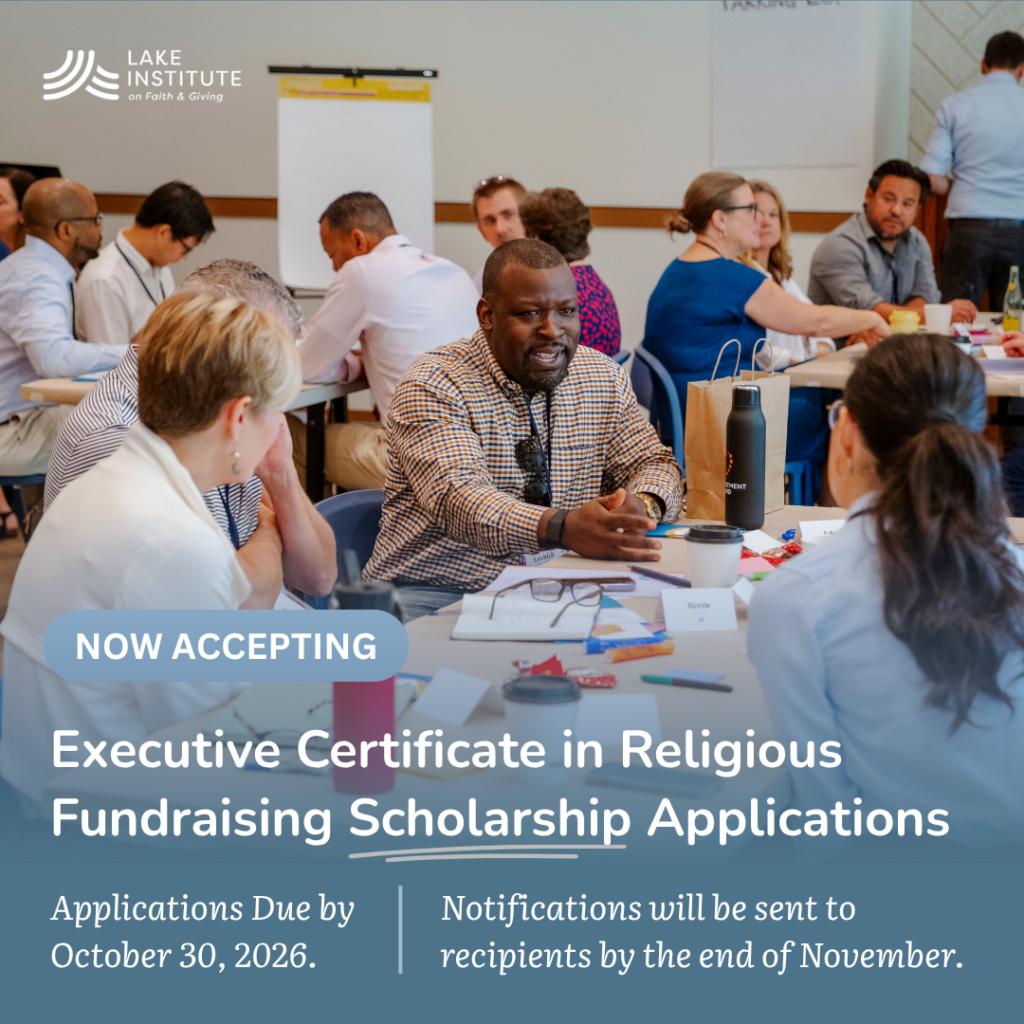
Scholarship applications are now open for the Executive Certificate in Religious Fundraising (ECRF) course. Applications will remain open through October 30, 2026, and recipients will be notified by the end of November.
These partial scholarships may be used toward ECRF courses in 2027, with final payments due by June 1, 2027. We encourage applicants to register for their preferred course while applying for the scholarship.
Now Accepting Applications for the Lake Institute Dissertation Fellowship

Applications are now open for the Lake Doctoral Dissertation Fellowship, supporting Ph.D. research at the intersection of faith and giving. The fellowship offers $33,500 in funding along with opportunities to engage with Lake Institute’s research community, resources, and expertise. Applications are due January 17, 2027.
Subscribe
Insights is a bi-weekly e-newsletter for the religious community and fundraisers of faith-based organizations that provides:
- Reflections on important developments in the field of faith and giving
- Recommended books, studies and articles
- Upcoming Lake Institute events