

Lake Doctoral Dissertation Fellowship
This one-year grant is given annually to support a graduate student whose research engages issues at the intersection of faith and giving. It is intended to support the final year of dissertation writing for a doctoral candidate at a U.S. graduate school.
Scope of research
This fellowship is designed for research at the intersection of faith and giving. The dynamic conversation at this intersection is enriched by scholarship across many disciplines.
We define faith and giving broadly, and we invite scholars to consider how their work may connect, even if they are not situated within religious or philanthropic fields of study. Faith includes Western and Eastern religions, spirituality and spiritual practices, emerging belief systems, and more. Giving includes philanthropy, volunteering, mutual aid, prosocial behavior, and other forms of generosity.
See the topics explored by past fellows here.
Timeline
- Application due date: Sunday, January 17
- Fellow selected: February 2027
- Fellowship period: Fall 2027 – Fall 2028
Required criteria for applicants
- Be a candidate for a Ph.D. degree at a graduate school in the United States.
- Fulfill all pre-dissertation requirements by December 31 of the year applying, including approval of the dissertation proposal with the expectation that the dissertation will be completed no later than July of the year following the fellowship grant year.
- Must not have received a similar grant or fellowship for the writing of the dissertation. Fellows may not accept other awards that provide similar benefits in the same academic year. We anticipate that with funding from Lake Institute, you will be able to complete and defend your dissertation during the fellowship year. If you are receiving a full stipend from your school, we ask that you bank or postpone it to accept the Lake Fellowship. Smaller awards and/or those involving limited opportunities to teach may be permitted, at the discretion of the Research Advisory Committee of Lake Institute on Faith & Giving.
Fellowship benefits
- Receive three award payments totaling $33,500
- Be invited to special research-focused Lake Institute engagements
- Have the opportunity to take advantage of Lake Institute’s resources and expertise
- Share your research through our website and citations in our seminars
Questions about this fellowship opportunity can be sent to Kelly Dunlap at keldunl@iu.edu.
How to apply
Application deadline: Sunday, January 17
1. Fill out the Application Form. You will need the following information in order to complete this form:
- Applicant: name, email, phone number, address
- School: name, address
- Dissertation Committee Chairperson: name, email, phone, address
- A one-three sentence summary of your fellowship proposal
2. Upload the required documents through the Application Form:
- Resume/CV
- Fellowship proposal: In your proposal of no more than seven pages (double-spaced, 12-point font), articulate the thesis of your dissertation, summarizing the argument, methodology, and current findings. In addition, discuss the relevance and contribution of your topic for the understanding of an important question(s) or issue(s) related to religion and philanthropy/faith and giving. Please write this executive summary so that scholars outside of your discipline would not have difficulty comprehending your proposal.
- Copy of the approved dissertation proposal.
- A selected bibliography: Compile a curated bibliography (2-3 pages, double-spaced) indicating the major theoretical, practical and critical works that bear on your dissertation. This means you should include those works that most clearly demonstrate your command of the scholarship necessary to write the proposed dissertation. In most cases this will already be part of your proposal.
- A timetable: Detailing your chapter outline, your progress to date, and your schedule for the fellowship year. It should be no longer than one page, double-spaced.
- Official or Unofficial Transcript: From the graduate school which will award the Ph.D. degree. Official Transcripts can be sent to LakeInstitute@iu.edu. Unofficial transcripts must be uploaded to the application form.
3. Request two letters of recommendation: One from your dissertation director and another from a faculty member familiar with your work. Share this upload link with recommenders to upload letters.
All application materials (application form, required documents, and letters of recommendation) must be received by January 17, 2027.

“The Lake Doctoral Dissertation Fellowship was a tremendous boost to my studies. Their financial support allowed me to do field research in Africa and write a much stronger dissertation than I otherwise could have done. And my association with the institute has introduced me to a new network of practitioners and scholars. I’m very grateful for the Lake Institute’s support of my work.”
2026 Lake Doctoral Dissertation Fellowship Recipient
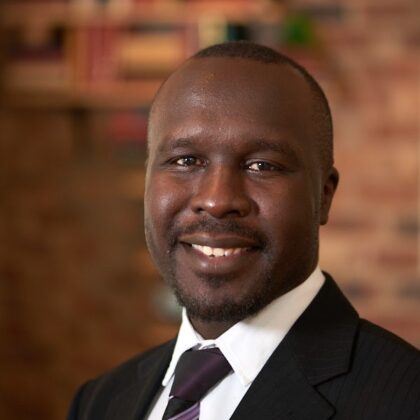
Kilama Dennis is a Ph.D. candidate at the Indiana University Lilly Family School of Philanthropy and is Enright Fellow. He previously worked with the church, the nonprofit sector, and academia in Uganda. His research is focused on the intersection of faith-based organizations, fundraising, African philanthropy, and financial sustainability. His dissertation is titled “Religious Identity and International Donor Funding of NGOs in Uganda: A Mixed Methods Approach.” This study examines how an organization’s religious identity influences its access to funding. He integrates his extensive practical experience working in Uganda with rigorous research on the history of philanthropic funding in Uganda, the categorization of faith-based organizations, and fundraising practices of faith-based organizations.
.