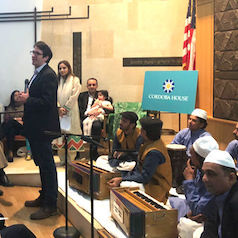
When a Muslim group needed a place for youth religious education, it began meeting at a synagogue. This arrangement led to mutual curiosity and real friendship.

 Lake Institute on Faith and Giving
This story collection highlights congregations and other religious groups who are using their assets and resources in creative ways as an expression of faithful giving. Each story is short enough to read and discuss during a committee meeting or other group gathering. Use these accessible vignettes to spark new questions, conversation, and imagination with your leaders about funds, buildings, land, and other resources in your care. If you know a story that should be included in the Story Shelf, suggest it here.

An enterprising pastor in Wilson, North Carolina pushed his congregation to revive its nonprofit and launch a plan to improve seven properties.
Amid calls for reparations, Arlington Community Church launched a foundation to lend interest-free funds to help Black Americans purchase their first home in their community.
Atlanta’s First Presbyterian Church launched a social entrepreneurship program to recognize how God was already moving in their city and to provide business mentorship and financial assistance to aspiring social entrepreneurs.

Despite limited financial resources, a Latino church in San Antonio has sustained a 20-year Thanksgiving meal ministry through the commitment and generosity of its congregation.
A synagogue brings together seniors and youth to talk about the change they want to see in the world, learn about local nonprofits, raise funds, and distribute grant money.
Instead of asking people to come to their church for a hot meal, Emmanuel Episcopal operated a free hot dog cart around the city to feed those experiencing homelessness.

The congregation of Biltmore United Methodist Church sold their property and is devoting their energy and resources toward responding to Asheville, North Carolina’s most pressing social needs.
A rural Tennessee church closes with one final, old-time singing and a donation to a Christian disaster relief agency.
Hudson River Presbytery transferred the title of former church to the Indigenous-led Sweetwater Cultural Center as a "pledge of partnership" and in an effort to make amends for harm done to Native American populations.

When a century-old congregation faced an enormous price tag for essential repairs, they found a way to stay, keep worshiping, and provide affordable housing for seniors.
Origin Church constructed a new building in hopes that their congregation would grow to fill it. When that didn't happen, they gave it to a local journalism organization whose values matched their own.
Through neighborhood canvassing, a pastor felt his church was called to be a convener of organizations already at work in the community, rather than create something new.
When a Muslim group needed a place for youth religious education, it began meeting at a synagogue. This arrangement led to mutual curiosity and real friendship.
A story about a Cooperative Baptist Fellowship congregation that is home to no less than five Birmingham-area nonprofit organizations and aside from the congregation’s weekly worship service, four other churches gather there on Sundays.
In 2004, the Muslim Center of Detroit partnered with physicians from the Islamic Association of Greater Detroit to open a free health clinic on the second floor of the prominent local mosque.

Bethel AME is helping to address the affordable housing crisis in San Diego by building affordable units on their property. They raised funds to offset construction costs enough to make the project self-sustaining.
Cass Community United Methodist Church plans to build a village of 25 tiny houses that the working poor or formerly homeless can rent to own.
Beyond the first step of acknowledgment, some faith communities are taking up concrete reparations as a way of demonstrating authentic repentance for their role in systemic oppression.
The Church of Jesus Christ of Latter-day Saints gave $32 million to the United Nations World Food Programme - the largest single donation to-date to a humanitarian organization - to fight the global hunger crisis.
First Baptist Church of Clarendon in Arlington, Virginia decided to serve its community by sharing its square footage for affordable housing, a child development center, and a seminary.
A monthlong fast led a church to donate $150,000 to students at HBCUs who needed financial assistance in order to graduate.
Farm Church does not own a church building but instead uses a lot of land from a local nonprofit that they farm each Sunday morning before worshiping together on the same property.